


A green light for cellular transport

Nobody likes waiting at traffic lights, but managed correctly, road signals keep the cars moving freely and help to prevent accidents and gridlock.
A very similar stop-and-go system is at work in every cell of the human body. Membrane channels control the movement of essential ions such as chloride, sodium, and potassium in and out of cells, helping each tiny biological unit maintain the correct chemical balance and power life-sustaining processes like respiration. Consequently, when these membrane channels malfunction, it can cause serious problems throughout the body: in cystic fibrosis faulty chloride channels mean the body produces overly sticky mucus which damages the lungs and digestive system, while dysfunctional sodium and potassium channels can trigger different types of epilepsy by disrupting the signals between nerve cells.
But what if it were possible to introduce a diversion around these faulty channels and get the ions in and out of the cell another way?
Scientists are particularly interested in producing synthetic replicas of these biological channels to treat diseases like cystic fibrosis and epilepsy and have already developed a number of molecular scaffolds which straddle cell membranes to shuttle different ions across. However, these artificial additions are not tapped into the cell’s standard circuitry so the channel design needs to incorporate an independent method for researchers to control the ion flow. And like on the road, light is the answer.
Researchers at the University of Oxford developed a series of light-sensitive molecular barricades, enabling them to switch on chloride ion transport across bilayer membranes using different wavelengths of light.
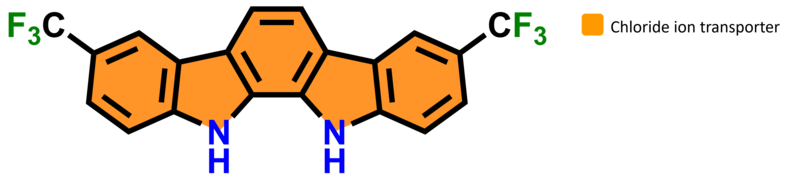
The transporter unit is based on an established chloride ion receptor, labelled in orange below. The spatial arrangement of the two central hydrogen atoms, each bonded to a nitrogen atom, allows weak attractions, known as hydrogen bonds, to form with chloride ions, enabling their continuous transport from one side of a membrane to the other, a little like pass the parcel. The first step was therefore to stop this constant flow of ion traffic by blocking these interactions.
But a crucial part of ion transport is being able to turn the flow back on when needed and the team consequently had to think very carefully about a suitable blocking method. They focused their attention on a family of compounds called photocages – bulky units which block the activity of a target molecule when bound, but are easily released using light to reactivate the molecule. The team investigated a nitrobenzyl photocage, shown in purple below. When fixed to the receptor binding site, this photocage prevents chloride ion transport across the membrane. However, brief exposure to purple light subsequently breaks the bond holding the cage to the receptor, unblocking it and restoring the flow of ions.

In life, it's always a good idea to have a backup so the team investigated a second photocage molecule at the same time. The second, called BODIPY, shown below, responds to green light.

They attached one of each photocage molecule onto the receptor unit, creating a double lock on ion transport: both green and purple light are needed to switch the system back on.

This double light activation will help scientists manage the flow of ions in much more complex living systems. Using different combinations of photocages, it may be possible to precisely target specific cells just by changing the colour of light used to trigger the transport of crucial ions to where they are needed most.This double light activation will help scientists manage the flow of ions in much more complex living systems. Using different combinations of photocages, it may be possible to precisely target specific cells just by changing the colour of light used to trigger the transport of crucial ions to where they are needed most.
This is Research Companion 002, part of Compounds of Interest, an Oxford Chemistry series exploring our research. Read the research paper behind this article: https://doi.org/10.1039/d6sc04824b
Acknowledgements: The Department is grateful to Wadham College for supporting the Compounds of Interest series through its Access programme. This Research Companion was written by Oxford Chemistry alum Dr Victoria Atkinson, in collaboration with the Compounds of Interest team and contributing researchers.

