


A molecule with half-Möbius topology
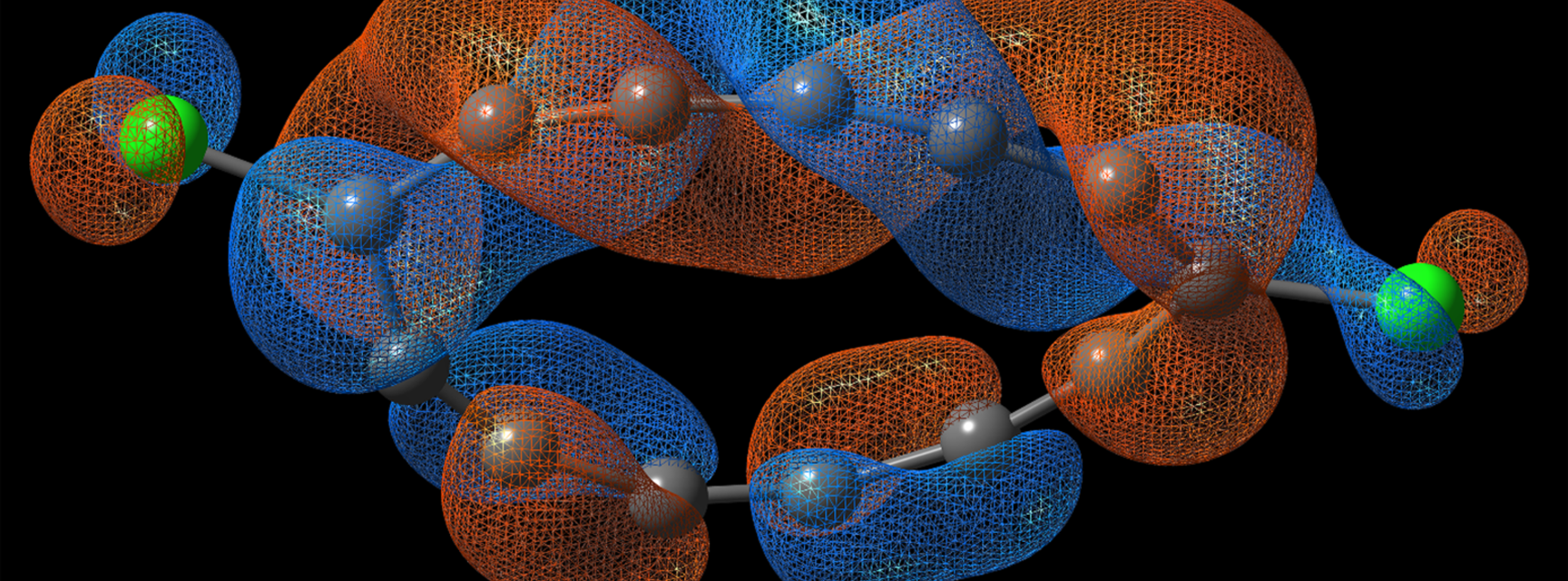
A collaboration between Oxford Chemistry, IBM Research (Zurich), the University of Manchester, ETH Zurich, EPFL Lausanne and the University of Regensburg has demonstrated an unprecedented molecular topology: the so-called half-Möbius topology. Using atom manipulation with a scanning probe microscope, the researchers created an exotic molecule, that is C13Cl2, a monocylic molecular ring, with a helical electronic structure that is qualitatively different from all previously known molecules.
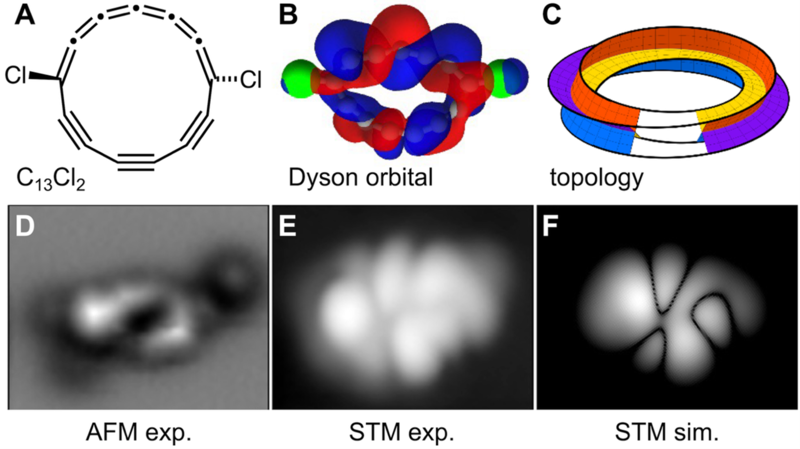
Image: A Molecular structure of C13Cl2, B Dyson orbital, C Schematic showing half-Möbius topology.
D Experimental AFM image. E Experimental STM image. F Simulated STM image. (From Science article)
- Atomic force microscopy (AFM) showed that C13Cl2 adopts a chiral geometry on a sodium chloride surface. Its π-system has a half-Möbius topology, corroborated by comparing experimental scanning tunnelling microscopy (STM) images with the calculated Dyson orbital for donating an electron to the molecule.
- The half-Möbius orbital basis twists by 90° in one circumnavigation of the ring, changes sign with respect to two circumnavigations and is periodic with respect to four circumnavigations.
- The enantiomers of C13Cl2 can be interconverted on the surface. A metastable, achiral, topologically trivial triplet state is also observed.
- Multireference calculations executed on IBM quantum hardware were essential for this discovery. These computations helped uncover the mechanism that stabilizes the unexpected topology and predicted helical molecular Dyson orbitals - a fingerprint of the half-Möbius topology.
The ability to create electronic systems with new topologies, combined with advances in quantum computing that enable their accurate theoretical description, opens the door to discovering new phenomena rooted in molecular topology. Ultimately, this combination of experiment and theory deepens our understanding of quantum physics, that is, the fundamental laws that govern our world.
You can read more about this study in Science. https://doi.org/10.1126/science.aea3321

