

Joseph Rufino Cordeiro Foundation (JRCF) Summer Research Studentships 2026
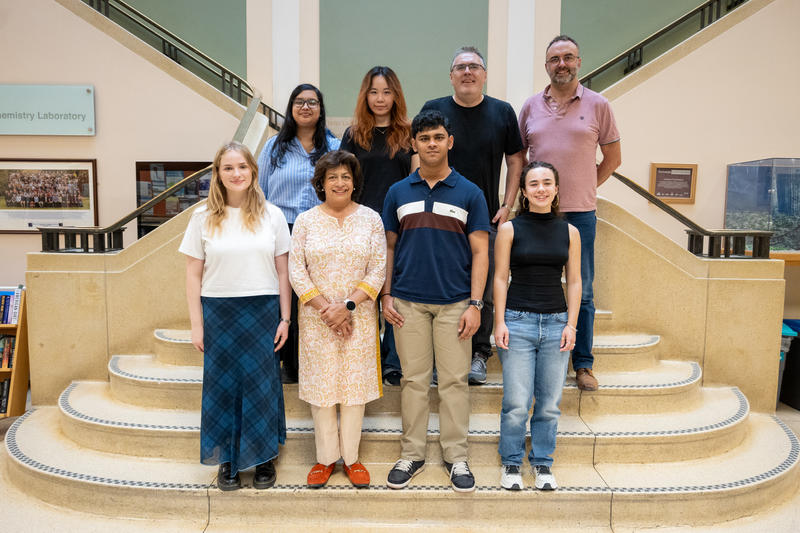
(L–R) Amelia Cantell, Nisha Sanjaykumar Limbachiya, Mary Anne Cordeiro (Chair of JRCF), Amanda Boc, Shlok Lakshminarayan, Prof Grant Ritchie (Professor of Chemistry), Sofia Garcia Alvarez, and Dr Martin Galpin (Associate Head of Department – Teaching).
Five undergraduate students joined Oxford Chemistry this summer for the 2026 Joseph Rufino Cordeiro Foundation (JRCF) Summer Research Studentships. Over eight weeks they worked on research projects covering areas such as sustainable synthesis, computational chemistry, photochemistry, energy storage and catalysis.
Now in its fourth year, the programme was established by the JRCF in partnership with the Department of Chemistry and Worcester College to give undergraduate students the chance to experience postgraduate research at Oxford. This year’s students joined the Congrave, Duarte, Durrant, McGonigal and Stamatakis research groups. The studentships have a particular focus on sustainable chemistry and widening access to research for students from groups currently under-represented in chemistry.
The JRCF was established in 2022 in memory of Joseph Rufino Cordeiro, a scientist of Goan origin who was educated in India. The Foundation is chaired by Mary Anne Cordeiro, an alumna of the Department of Chemistry and Worcester College. It supports scientific research and helps early-career researchers develop their research skills and experience.
During July and August, the students worked on problems including the development of new light-emitting molecules, photoelectrochemical plastic reforming, computational studies of catalytic reactions and new materials for batteries. The students also stayed together at Worcester College, giving them a chance to experience life in Oxford together beyond the lab.
Read on for reflections from all five 2026 JRCF students on the challenges and rewards of research, the skills and confidence they developed as part of the programme, and the friendships they have made during the summer.
Mary Anne Cordeiro, Chair of JRCF Board of Trustees, said:
The Foundation is delighted to continue to support the cohort of five JRCF students for the fourth year. We were particularly pleased with the large number of applications we received this year which made the bar for successful candidates even higher. I was delighted that four of the five students were women and that two of the five were of Indian origin. All have been inspired by their work over the summer to continue to seek a career in sustainable chemistry research.
Professor Grant Ritchie, Professor of Chemistry and Fellow of Worcester College, said:
The JRCF Summer Research Studentships give students a unique opportunity to experience life as a researcher while helping to widen access to research opportunities in chemistry. It has been wonderful to see this year’s cohort embrace challenging scientific projects, grow in confidence and become part of our research community. Their enthusiasm and curiosity have been inspiring, and we are grateful to the Joseph Rufino Cordeiro Foundation for making these opportunities possible.
The 2026 JRCF students describe their summer research experiences below:
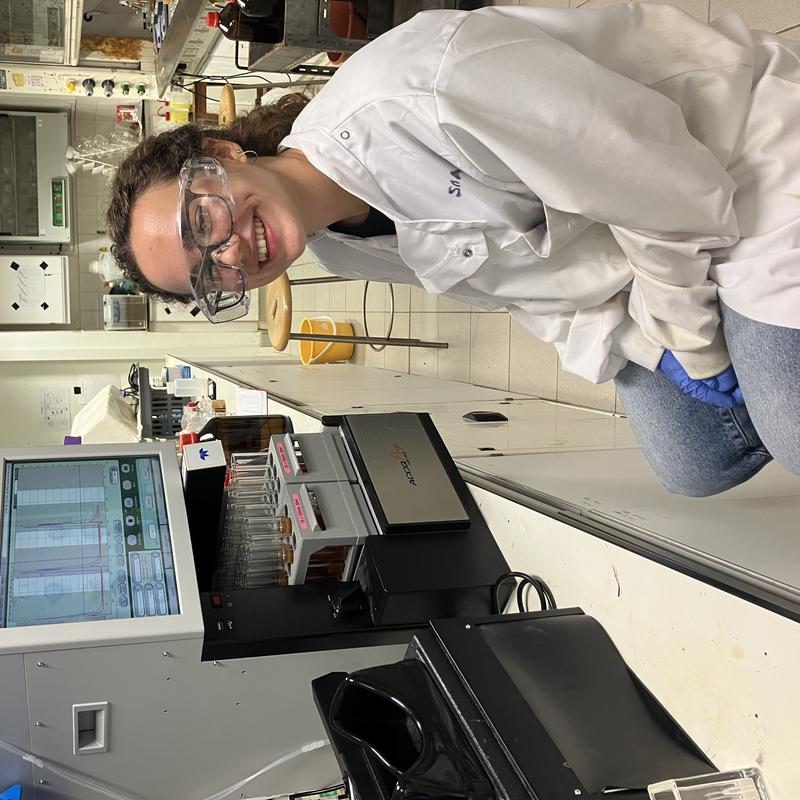
I wanted to work on sustainability even before I decided to study chemistry. I have always wanted to contribute to addressing climate change, and chemistry is my chosen way to approach these challenges. I really enjoy being in the laboratory: setting up reactions, seeing what happens, and working out why something has or has not worked. I therefore wanted to find out what a career in research would be like. Combined with my interest in sustainability, this led me to apply for the JRCF studentship.
I joined the Congrave Group, where I worked on a research theme being developed by DPhil student Pawel Grab, who was also my mentor. My original project focused on synthesizing 3BN, a near-infrared multi-resonance thermally activated delayed fluorescence (MR-TADF) molecule, and peripherally attaching substituents to increase its reverse intersystem crossing rate. However, the precursor to this MR-TADF proved more difficult to synthesize than expected. Pawel and I thus spent the first weeks exploring different conditions before eventually finding the optimal ones. I then worked through the synthesis of 3BN, as well as exploring other related MR-TADFs. Although I did not have time to make the 3BN derivatives, I successfully obtained 3BN and gained experience troubleshooting the challenges involved in its synthesis. The experience taught me that research is rarely as straightforward as it appears on paper.
More than anything, I enjoyed being part of the Congrave Group. I worked alongside my mentor and quickly became involved in the everyday life of the group: attending meetings, presenting my work, joining the weekly group drinks… I am left with many great memories of these two months; one of my favorites is staying late with Pawel to finish our experiments, ordering pizza and playing games while we waited.
The studentship has given me my first real insight into life as a researcher. I have learnt synthetic techniques I hadn’t encountered before, such as air- and water-sensitive chemistry and HPLC, while also experiencing the whole process of research: reading literature, planning experiments, troubleshooting, analyzing results and presenting them.
It has also allowed me to meet some very cool people, not only those in the Congrave Group but also the rest of the JRCF cohort, who have made the summer so much more memorable. We always found something different to do, whether it was ice- skating, playing Spanish card games, watching the World Cup, or even punting and pub quizzes.
Despite the intensity of the summer, it was an amazing experience, and I was genuinely sad to leave. I am very grateful to Pawel, the Congrave Group, my fellow students, Worcester College and JRCF for the opportunity. This experience has made me much more interested in pursuing a PhD and continuing to work in sustainable chemistry.

I have always been interested in sustainable chemistry and during my two years of studying chemistry at university, I realised I particularly enjoyed computational chemistry. I was keen to combine my interests in sustainable and computational chemistry in a research environment, so the JRCF studentship seemed like the perfect opportunity to gain hands-on experience in this field!
For the studentship, I joined the Duarte group, where my project initially involved understanding the effects of different solvents on Palladium-catalysed C-H activation reactions. This was investigated computationally using Density Functional Theory (DFT) by optimising reactant, transition state and product geometries in implicit solvents. I then investigated the effect of replacing the phosphine ligand on the Palladium catalyst with a coordinating solvent ligand in implicit and explicit solvents. To complement the static DFT picture, machine learning interatomic potentials (MLIPs) were also used to study the dynamic stability in explicit solvent boxes. Over the course of this project, I was able to achieve most of the goals I had set out in my initial project proposal, which made this experience particularly rewarding. I have significantly developed confidence in DFT and gained my first exposure to MLIPs. More broadly, I have grown in my ability to think critically about computational results and approach complex chemical problems with greater independence.
I am incredibly grateful to my mentor, Dr Veronika Juraskova, for her support throughout this project. She generously gave her time to teach me new computational techniques, explain complex ideas and answer many questions. Through her mentorship I not only developed new technical skills but also grew in confidence as a researcher. I am also grateful to the rest of the Duarte group who were always happy to help whenever I had any issues or queries.
Staying at Worcester College was an experience I will not forget; the beautiful gardens and lake made it a perfect place to relax, while the meals served in the dining hall made me feel truly immersed in Oxford life. I was also very lucky to form close friendships with the other JRCF students. From exploring Oxford and getting food together to spontaneous adventures like punting and weekly ice-skating sessions to escape the heatwave. It was a truly memorable summer both inside and outside the office!
The studentship exceeded my expectations in every way, from working as part of a research group at the University of Oxford and experiencing academic research, to staying at Worcester College and immersing myself in student life. I have really enjoyed every aspect of this experience and feel very fortunate to have had this opportunity.
I would like to thank Mary Anne, Grant and the JRCF for making this experience possible, and I would also like to thank Fernanda Duarte and the Duarte group for their support this summer!
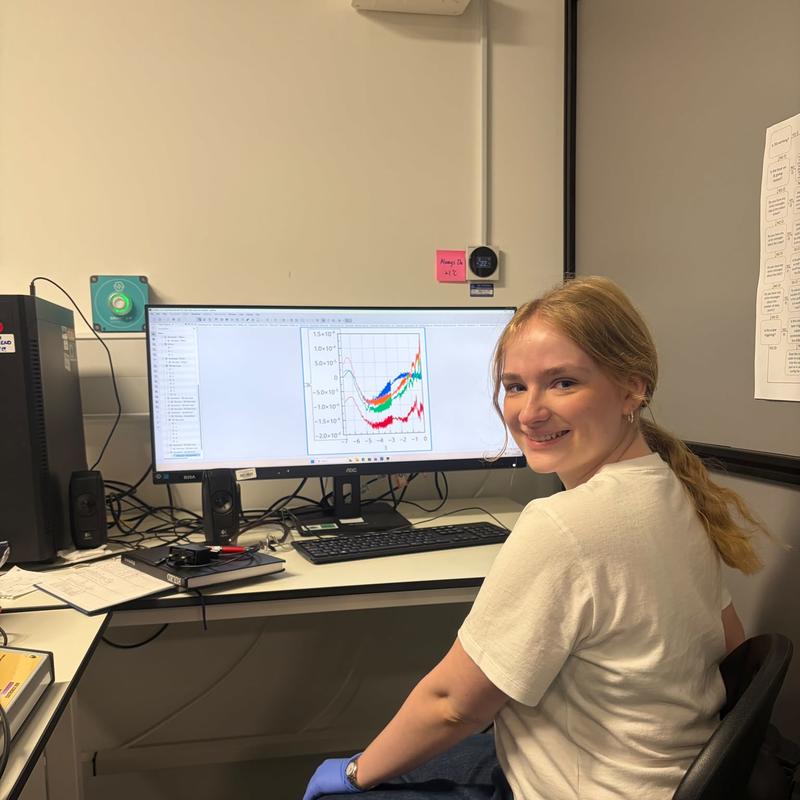
I applied for the JRCF studentship because I wanted to experience what research would be like in the topics that interested me the most during my undergraduate degree. Two years ago, I came across the JRCF website and read what previous students have done throughout their time doing research at Oxford. This encouraged me to apply in my second year. Upon finding out that I had been accepted, I was excited by the opportunity to gain hands-on experience and explore photochemistry further.
Building upon the group’s previous work on water oxidation, photoelectrochemical (PEC) reforming of ethylene glycol (EG) also provides an alternate substrate to water, where efficiency is limited due to its high activation energy and sluggish four-electron transfer. My project focused on the PEC reforming of polyethylene terephthalate (PET), a widely used plastic whose accumulation poses a significant environmental challenge. PEC reforming offers a promising and more energy-efficient route for converting PET-derived EG into value-added products. My work investigated EG oxidation under different conditions and explored how photogenerated charge carriers can be observed under illumination, which potentially provided mechanistic insight through the determination of reaction kinetics.
From the beginning of the studentship, I was made to feel very welcome by the group. It was particularly nice to experience the dynamics within a research group and see how people with different projects and areas of expertise worked alongside and supported one another. My mentors guided me through techniques that were completely new to me, including how to assemble a three-electrode setup for electrochemical testing and how to investigate EG oxidation under both dark and illuminated conditions. Their guidance helped me become increasingly confident working independently, while still having support whenever I encountered something unfamiliar or unexpected.
I never knew I could learn so much in two months, and yet I also feel as though I have only dipped my toes into this sector. I expected to develop practical laboratory skills and learn more about my project area, but I did not anticipate how much exposure I would gain to the wider field. Through regular group meetings, I discovered that although many people were using photochemistry, they were applying it to different problems. I found this very interesting and it made me appreciate how broad the field is. It was particularly exciting to see research actively working towards a more sustainable future and to contribute, even on a small scale, to that wider goal.
Another highlight of the studentship was my time spent at Worcester College and living with the other JRCF students. I will miss our weekly ice-skating sessions, evening drama show watches and some of our more serious chats about the research we were undertaking. Worcester provided a great setting for our Oxford experience. I will even miss petting the little black cat that would greet us by the cricket pitch.
Overall, I will forever be grateful to the JRCF for funding and offering me this opportunity and the Durrant group for welcoming me and allowing me to contribute to their research. Although two months has taught me an incredible amount, it has also shown me how much more there is to discover, and I hope to continue exploring this area in the future.
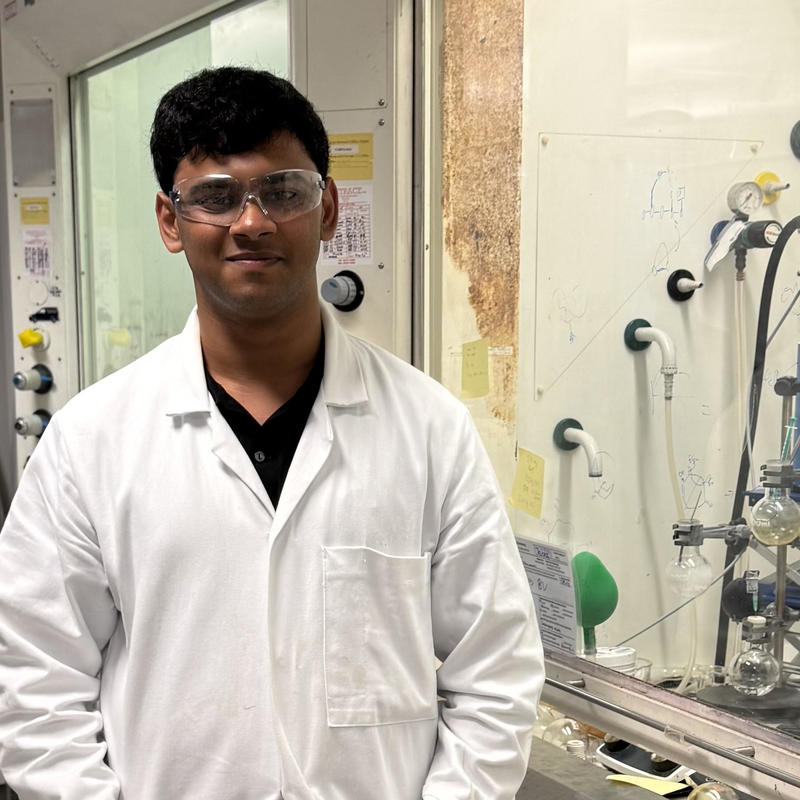
Coming towards the end of my second year at Oxford, I found myself questioning what a career in research entailed. I was increasingly curious about the transition from taught, well-understood chemistry to the process of understanding novel systems – particularly those which exhibit unusual behaviour. My strong focus on the synthesis of functional organic molecules drove me to apply to the McGonigal Group, whose work with non-traditional molecular architectures offered both the conceptual and experimental challenges I was after.
The group developed a state-independent organic electrolyte (SIE) based on a tri-substituted cyclopropenium core which acted as the platform for my project. SIEs aim to combine the advantages of both liquid and solid electrolytes while minimising their individual limitations. The parent SIE.Chloride (Cl) systems suffer from low absolute conductivities, which I proposed to improve by producing a series of sodium salt-doped materials at varying SIE: sodium salt ratios(mol%), based on anion-exchanged SIEs. Beyond pushing conductivity to an industrially viable level, the added sodium ion carriers open the possibility of using these materials as sodium-battery electrolytes.
After a warm welcome into the lab by my supervisor (Souma), lab mates and PI, I began by conducting bulk-scale syntheses of several SIE.Cls. By the end of the programme, I had used these as a base for a range of new anion-exchanged and doped materials for further testing in the group. Outside synthesis, I gained experience in interpreting spectroscopic data to draw conclusions, often where there was no clear one-to-one relationship to rely on.
Souma was pivotal throughout the entire process, guiding me through the relevant lab techniques, troubleshooting with me and answering the many questions I had. I’m very appreciative of the time he invested both in and out of the lab, making sure I was on the right track while still giving me the space to work things out independently and learn from my mistakes.
The cohort I spent the summer with made it genuinely memorable. We went punting, often ate dinner together and spent our evenings chatting and unwinding after long days. It helped that Worcester was such a great base with excellent accommodation, catering and a beautiful lake to enjoy. Having their support through the entire process made the experience even more enjoyable.
I’m deeply grateful to the JRCF and Mary Anne Cordeiro for this opportunity, and to Professor Grant Ritchie for his support in organising the studentship. I’d also like to thank Professor Paul McGonigal for his guidance throughout my project and for welcoming me into his group over the summer. This experience has far surpassed my expectations, giving me real clarity on the direction I’d like to take going forward.
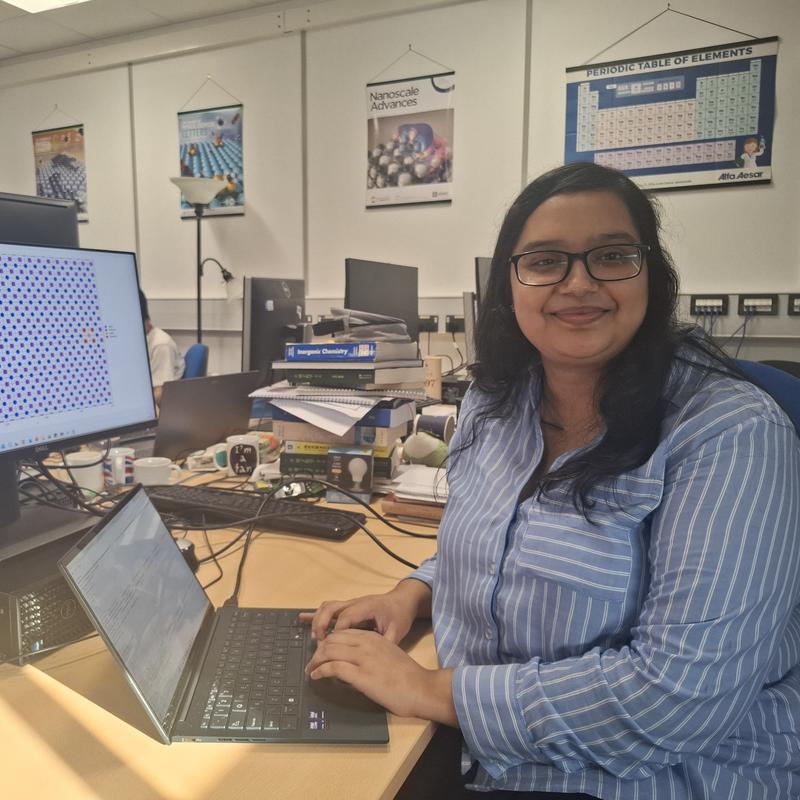
Having completed three years of my MChem degree, I wanted to further develop my passion for sustainable chemistry by exploring how catalysis can improve the efficiency of producing fuels from renewable sources, such as biomass. So, when I came across the Joseph Rufino Cordeiro Foundation Summer Studentship, I knew it would offer me the perfect opportunity to gain an insight into how the performance of catalysts can be improved to help increase public access to renewable fuels globally.
Specifically, I wanted to focus on Single Atom Alloy (SAA) catalysts. SAA catalysts contain isolated dopant atoms that are dispersed into a coinage metal host surface. This means that these catalysts can access both the high activity offered by their dopant atoms and the high selectivity offered by their host metal.
What drew me to the Stamatakis group was their use of the Graph Theoretical Kinetic Monte Carlo (GT-KMC) method to simulate reactions on the catalytic surface over time, focusing on the occurrence of rare events. This method bridges the gap in scale between DFT calculations and macroscopic properties, so the performance of the catalyst can be assessed under real, dynamic conditions.
Hence, my project aimed to utilise GT-KMC simulations to compare the dissociation of formic acid into hydrogen gas on different copper (Cu) (100) SAA catalysts under temperature-programmed desorption conditions. Consequently, I simulated this dissociation reaction on Cu-Rhodium (Cu-Rh), Cu-Nickel (Cu-Ni), Cu-Palladium (Cu-Pd) and Cu-Platinum (Cu-Pt) SAA catalysts before comparing them against the reaction on a pure Cu lattice. Thereafter, I simulated the reaction on different Cu-Pt SAA catalysts, where I varied the Platinum dopant coverages from 0.01% to 0.10%.
During my project, I was supported by my mentor, Dr Weitian Li, whose guidance helped me build confidence to navigate the errors I encountered when downscaling some of the diffusion elementary steps. I also really appreciated the warm, welcoming and collaborative environment of the Stamatakis group, which allowed me to learn new skills and has inspired me to pursue a career in research.
By the end of my project, I found that the most effective SAA catalyst in reducing the temperature of the rate-determining C-H activation step was the Cu-Rh catalyst and the least effective was the Cu-Pd catalyst. Meanwhile, increasing the Platinum dopant coverage by tenfold led to a small decrease in the temperature needed for the C-H activation step. Therefore, this studentship exceeded my expectations as it allowed me to gain a better understanding of heterogeneous catalysis and the factors that can affect its catalytic performance.
Beyond the lab, I really enjoyed exploring Oxford, trying ice-skating and singing karaoke with my JRCF peers. I also loved spending time admiring the beautiful grounds of Worcester College, and I am truly thankful to them for hosting us this summer.
Finally, I am deeply grateful to Mary Anne Cordeiro, Grant Ritchie and the Joseph Rufino Cordeiro Foundation for this amazing opportunity, which has further strengthened my passion for sustainable chemistry and empowered me to pursue a PhD in this field.

