


Launch of EPSRC CDT in Chemical Synthesis for a Healthy Planet
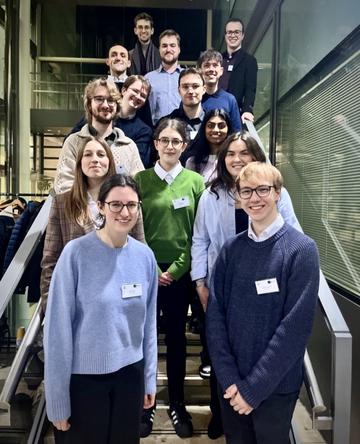
The first cohort of CSHP CDT students, in Oxford's Chemistry Research Laboratory.
The University of Oxford Department of Chemistry marked the launch of the EPSRC Centre for Doctoral Training in Chemical Synthesis for a Healthy Planet (CSHP CDT) on 12 January 2026, with an event featuring a symposium, a drinks reception, and a networking dinner.
The CSHP CDT, delivered jointly by the Universities of Oxford and York, brings together expertise in chemical synthesis, catalysis, and green chemistry, to train the next generation of synthetic chemists to address global sustainability challenges. The programme unites over forty academics across the two universities with ten industrial partners, who have been closely involved in the design of the CDT and who co-develop and co-supervise PhD projects, as well as ten SMEs who offer complementary expertise and training opportunities. The launch event, hosted in Oxford’s Inorganic Chemistry Laboratory, showcased the scientific ambition and collaborative ethos underpinning the programme.
The symposium opened with a welcome from Professor Michael Willis, CDT Director, alongside Professor Irene Tracey, Vice-Chancellor of the University of Oxford. In her opening remarks on the importance of sustainability-focused research, Prof. Tracey described the CSHP CDT as ‘one of the most exciting STEM-related programmes’ that she had seen in her three years as Oxford’s Vice-Chancellor.
Two scientific sessions followed, featuring talks from internationally leading researchers spanning circular chemistry, catalytic mechanisms, green chemistry, chemical biology and sustainable materials. Speakers included Professor Peter Seeberger (Center for the Transformation of Chemistry); Professors Helen Sneddon and Antoine Buchard (University of York); and Professors Chris Schofield, Martin Smith, Michael Neidig and Véronique Gouverneur (University of Oxford). The sessions were chaired by senior representatives from two of the CDT’s industrial partners: Dr Peter Jones (Vertex Pharmaceuticals) and Dr Oscar Mammoliti (Johnson & Johnson Innovative Medicine).
The symposium concluded with closing remarks from Professor Helen Sneddon, CDT Co-Director, followed by a drinks reception at the Chemistry Research Laboratory. The reception included addresses from Professor James Naismith, Head of the MPLS Division, and Professor Ed Anderson, CDT Co-Director, who spoke on the importance of CDTs in training the next generation of synthetic chemists and strengthening the Department’s research in sustainability.
By combining world-leading research with a unique collaborative academic-industry training programme, the CSHP CDT will equip its students with the skills and perspective needed to develop chemical solutions that support a healthier, more sustainable planet. The programme will produce sustainability-minded synthetic chemists capable of tackling global challenges in Human Health, Food Security and Energy and Materials.
Prof. Willis, CSHP CDT Director, commented:
It was a day of inspiring science, that really showcased the breadth of chemistry that the CDT will pursue, and perfectly set the scene for the exciting research to come.
Prof. Sneddon, CSHP CDT co-director, added:
As we complete the intensive taught phase of the programme it was wonderful for students, academics and industry to collectively celebrate, and the enthusiastic discussion around future projects bodes well for the research phase and beyond.
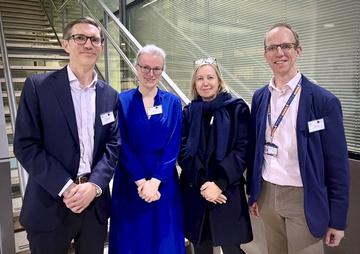
CSHP CDT Directors (L–R): Profs Michael Willis, Helen Sneddon, Véronique Gouverneur, and Ed Anderson.

