


New method combines experiment and computation to find more efficient catalysts
A new method that combines computation and experiment to design better enzyme-like catalysts has been developed by researchers from the Universities of Oxford, Edinburgh and Birmingham.
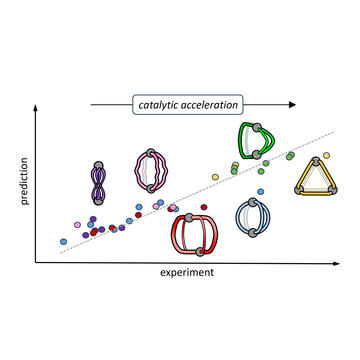
The study, recently published in the Journal of the American Chemical Society, introduces a new framework that combines wider and quicker experimental screening of possible catalyst structures with computational insights.
Nature’s catalysts – enzymes – use precisely engineered cavities to bind molecules and accelerate chemical reactions. Inspired by this principle, chemists have developed artificial analogues called cages, which use hollow three-dimensional metal-organic structures to mimic the way an enzyme holds a substrate.
Understanding what makes one of these cages a better catalyst than another remains challenging. Traditionally, the rate at which we can develop these catalysts has been limited by labour-intensive processes to purify and characterise the candidate molecules.
Now, experimental work led in Edinburgh by postdoctoral researcher Dr Laura Bickerton in Prof Paul Lusby’s group has established a rapid screening protocol that bypasses traditional methods and allows many molecular cage catalysts to be tested readily.
Dr Bickerton said:
This method allows us to access and investigate a wide range of molecular cages that would otherwise be difficult to isolate and study, giving us new insights into how we can tune catalyst functionality.
In collaboration with molecular cage expert Dr Jamie Lewis at the University of Birmingham, this new method was used to investigate the catalytic activity of 30 different structures, in what is one of the most comprehensive studies to date. This method expedited the discovery of nine new active catalysts for the nitro-aldol reaction, an important carbon–carbon bond-forming transformation. In total, the 30 cages showed a 10,000-fold difference in activity, spanning the least to most proficient catalyst.
To understand why these cages performed differently, Dr Tomasz Piskorz, postdoctoral researcher in Prof Fernanda Duarte's group at Oxford introduced a new computational method that combined data-science with mechanism.
Using computationally derived descriptors that capture the molecules’ shape, size, volume and electrostatics, the team developed a machine learning model to accurately predict catalytic activity. Dr Piskorz said:
Machine learning can correlate such features with reactivity, leading to a model with remarkable accuracy.
The team’s analysis also identified the specific properties most strongly linked to high catalytic performance, finding that geometric preorganization and electrostatic interactions within the cage were most strongly associated with high catalytic efficiency. Further density functional theory (DFT) calculations provided a rationale for these relationships, revealing why certain cages are much better at stabilising high-energy charged intermediates that facilitate catalysis.
Dr Piskorz said:
“It is always exciting to see how different computational methods, such as density functional theory (DFT) and machine learning (ML), complement each other. We use ML to analyse large sets of cages that are out of reach for slow DFT methods. In the few cases where ML reaches its limits, DFT helps us understand the origin of catalysis in these systems. Together, they tell the full story of the origin of the catalysis”
This combined experimental and computational study represents a step toward predictive, data-guided design, enabling experimental scientists to target highly-efficient catalysts for different chemical reactions.
Read more in the study, “Expanding chemical space enables data–driven structure–activity relationships in cage catalysis”, published in JACS.

