

Oxford Chemistry spinout awarded £100,000 to transform real-time river pollution monitoring
Mode Labs, a spinout from Oxford’s Department of Chemistry, has been awarded £100,000 to develop and trial its CERES autonomous chemical monitoring platform.
Mode Labs is one of 20 finalists in Ofwat’s £7.5 million Water Discovery Challenge, which aims to accelerate the development and adoption of promising new innovations from outside the water sector.
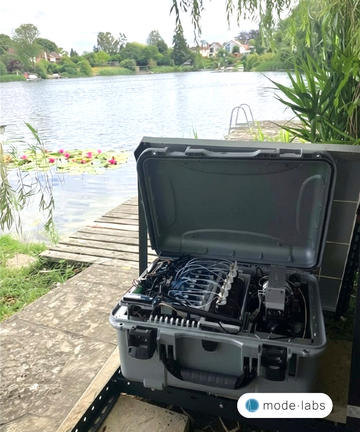
Mode Labs’ CERES autonomous chemical monitoring platform during a field deployment for real-time water quality monitoring.
CERES is a self-contained autonomous chemical monitoring platform that continuously analyses water in the field and makes laboratory-quality chemical data available remotely in real time. The system automatically collects tiny water samples, prepares them for analysis and continuously measures target chemicals without the need for routine manual sampling.
Much of today’s chemical water quality monitoring still depends on laboratory analysis of samples collected at intervals. While highly accurate, this approach provides only occasional snapshots of what is happening and can delay the detection of pollution events.
By bringing laboratory-quality chemical monitoring directly into the field, Mode Labs aims to help water companies detect pollution sooner, make better-informed operational decisions and protect rivers through continuous monitoring of harmful chemicals in rivers and sewer overflows.
Based at Begbroke Science Park near Oxford, Mode Labs was spun out from the Departments of Chemistry and Materials to commercialise pioneering Oxford research in optical microcavity technology, originally developed for quantum computing.
Claire Vallance, Professor of Physical Chemistry and Technical Director of Mode Labs, said:
We are delighted to receive recognition and support for our work from Ofwat, as we transition our sensors from the lab into the outside world. It is really exciting to be developing tools that we hope will play an important role in improving the health of the UK’s waterways.
Dean James, CEO of Mode Labs, said: “Our ambition is to replace occasional snapshots of river health with a continuous picture of what is happening across rivers and sewer networks. By making laboratory-quality chemical monitoring far less costly and maintenance-intensive, we can help the sector detect pollution sooner, direct investment more intelligently and protect rivers at a scale that has been difficult to achieve using conventional monitoring approaches. Support from Ofwat allows us to demonstrate that vision in real-world conditions and accelerate the route towards commercial deployment.”

