


Oxford chemists unlock Appel fluorination with KF
- Researchers at the University of Oxford, in collaboration with Pfizer, have developed a new method for converting alcohols into alkyl fluorides using potassium fluoride (KF).
- Published today in Science, the study overcomes a long-standing challenge in Appel-type fluorination: the undesired formation of PPh3F2 instead of C–F bond construction.
- The reaction opens up a new avenue for synthesising fluorochemicals, which are widely used in materials, agrochemicals and pharmaceuticals.
Alcohols are among the most abundant building blocks in chemistry. Fluorinated compounds, meanwhile, are essential for many modern medicines, crop protection products and advanced materials. Converting one into the other, however, has traditionally relied on toxic, thermally unstable reagents such as DAST (diethylaminosulfur trifluoride) that make large-scale manufacturing operationally demanding.
Researchers are therefore seeking safer and more practical ways to carry out these fluorination reactions. One major goal is to use simple, inexpensive and widely available fluoride sources such as potassium fluoride in order to make the process safer, more scalable and more sustainable.
Now, a University of Oxford team led by Professor Véronique Gouverneur (Department of Chemistry) has revisited the classic Appel reaction, a widely used method for converting alcohols into alkyl halides – molecules containing a carbon–halogen bond. This landmark method is currently limited to converting alcohols into all alkyl halides except for fluorides. The reason for this is that fluoride ions form a stable side product (PPh3F2) instead of reacting with the alcohol to produce the desired fluorinated compound.
Researchers at Oxford have now invented a neopentoxyphosphonium salt that avoids the formation of the unwanted side product PPh3F2. This novel salt works with potassium fluoride to form a reactive intermediate capable of activating the alcohol substrate for subsequent fluorination.
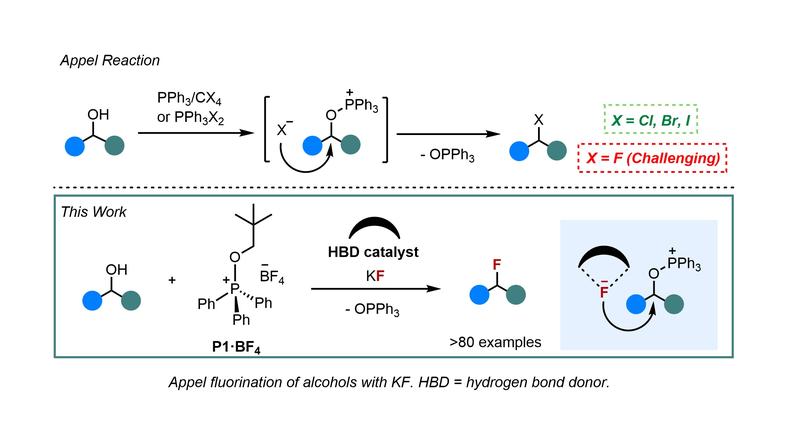
Using this strategy, the team synthesised more than 80 fluorinated molecules, including a range of (hetero)cyclic and bio-relevant alkyl fluorides, with yields of up to 98%. They were also able to generate enantioenriched fluorochemicals from readily available racemic starting alcohols – a particularly difficult transformation because conventional fluorinating methods require starting materials that are already enantioenriched.
Importantly, this new technology does not rely on the supply chain of hazardous chemical hydrogen fluoride (HF), which is currently used in almost all fluorination chemistry. The fluoride-containing chemicals that are necessary for synthesising the team’s novel reagent can themselves be directly prepared from the widely abundant mineral fluorspar. Such technology was developed previously by Professor Gouverneur and her team, in Oxford: Fluorspar to fluorochemicals upon low-temperature activation in water. Nature 635, 359–364 (2024).
Both the catalyst and the phosphine oxide by-product can be recovered and recycled after the fluorination reaction, minimising waste and therefore incorporating key principles of circular chemistry that improve the sustainability of the process.
This novel potassium fluoride-based Appel fluorination could help pave the way toward a simpler, safer, and more sustainable circular fluorine economy.

