


π electrons are key to aromatic hydration
Researchers reveal the hidden role of weak hydrogen bonding
A group of researchers from the University of Oxford, UCL, and the ISIS Neutron and Muon Source have revealed how weak, non-classical hydrogen bonds help govern the hydration and solubility of aromatic molecules in water. Their results provide new insights into molecular behaviour relevant to biomolecular behaviour and the design of pharmaceuticals.
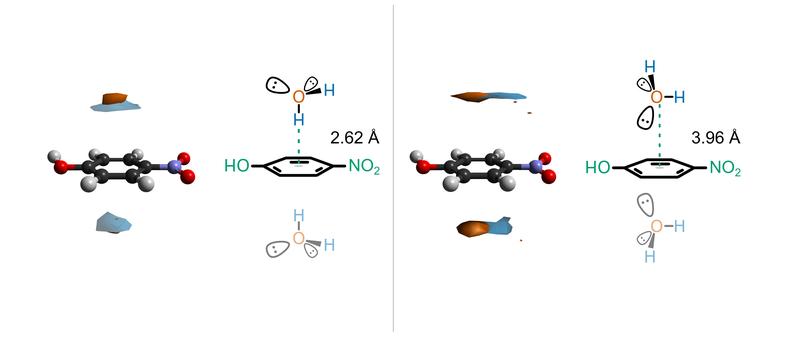
OH···π interaction between p-nitrophenol and water. At short distances (up to 3.6 Å), weak non-directional hydrogen bonding occurs; at longer distances (up to 4.5 Å), OH···π* contacts dominate, as also shown in this study for the liquid state.
Aromatic rings are key structures in organic chemistry. Derived from benzene, they contain delocalised π electrons whose distribution depends on the functional groups attached to the ring. Their rigid structure makes them important building blocks in biomolecules such as chlorophyll and pharmaceuticals such as ibuprofen.
The properties of these larger molecules depend strongly on how they interact with their surroundings, particularly water – the medium of life. Although aromatics are ubiquitous in pharmacy and structural biology, benzene and other simple aromatics are insoluble in water – a phenomenon commonly explained with the empirical ‘like dissolves like’ rule. Understanding exactly how water interacts with aromatic rings is therefore important for explaining processes ranging from molecular recognition and protein–ligand binding to pharmaceutical solubility.
Experimentally resolving these weak interactions in liquids has, to date, proved difficult. Much of what we know about their geometry comes from molecules in solid state constrained geometries or gas phase dimers. These scenarios cannot capture the subtle complexities of the liquid phase, which is so important to many biological and chemical processes. In liquids, dynamic bonds are mutually interdependent and rely on cooperative mechanisms to modulate solubility.
Researchers from the University of Oxford, working alongside collaborators at UCL and ISIS Neutron and Muon Source have now used total neutron scattering, hydrogen/deuterium isotopic substitution and computer modelling to investigate the forces governing aromatic hydration. They studied three archetypal aromatic molecules in water: phenol, aniline and p-nitrophenol. This choice of molecules allowed them to compare how OH, NH2 and NO2 groups alter the interactions between an aromatic ring and its surrounding water molecules.
The study, recently published in Nature Communications, characterises the classical hydrogen bonding between the functional groups and water, and reveals weaker, non-classical hydrogen bonds involving the delocalised π electrons in the aromatic rings.
“We propose a new way of thinking about aromatic hydration and solubility in water,” explains Dr Camilla Di Mino, Glasstone Research Fellow in Chemistry at Oxford’s Department of Chemistry. “In this new way of thinking it is the weak hydrogen bonding that drives solvation, rather than classical hydrogen bonding, dipole-dipole, or dispersion forces.”
The experiments revealed short, directional interactions between the O–H bonds in water and the π electrons in both phenol and aniline, where a water molecule points one of its hydrogen atoms towards the electron density at the centre of the aromatic ring. These interactions were virtually absent in p-nitrophenol, which is striking because p-nitrophenol’s nitro group provides an additional hydrogen-bonding site that might intuitively be expected to increase its interaction with water. Yet, despite strong classical hydrogen bonding between water and the substituents of p-nitrophenol, the loss of the weaker π interactions was seen to coincide with a reduction in solubility by a factor of around eight.
The team also found evidence for another unusual interaction in p-nitrophenol. The strongly electron-withdrawing nitro group creates an electron-deficient region, or ‘π-hole’, in the molecule. This allows water to interact with the aromatic molecule in a reversed orientation: rather than pointing one of its hydrogens towards the electron-rich π cloud, an oxygen lone pair points towards the electron-deficient region of the aromatic system (a π* orbital).
“These interactions have only recently been identified in the solid and gas phases,” says lead author Di Mino.
The existence of such motifs in the liquid state has been contentious, as until now direct evidence has been elusive. In this study, we provide unequivocal experimental evidence of HO···π* interactions in liquids, and we fully characterise their structure and geometry atomistically.
These findings show how weak interactions that are easily overlooked can reorganise the surrounding water network and contribute to measurable differences in bulk properties, such as solubility. Accounting for these effects could improve the molecular models we use to understand more complex processes, including protein–ligand binding and pharmaceutical behaviour.
Future work will explore whether these mechanisms also apply to biochemically relevant systems, with the aim of identifying more general molecular patterns and, ultimately, understanding how subtle changes at the molecular level can be used to control macroscopic properties.
The full paper, Weak hydrogen bonding as the driver of aromatic hydration, is published in Nature Communications and can be found at DOI: 10.1038/s41467-026-76528-x.

