


Zintl chemistry in the amorphous state
20 December 2025
Understanding materials behaviour at the atomic scale is key to developing batteries, catalysts, or solar cells. Machine-learning-driven computer simulations now enable detailed insights into atomic structures and dynamics, opening new opportunities to examine the complex working mechanisms of devices.
In a study published this week in Angewandte Chemie, researchers at Oxford Chemistry use such state-of-the-art simulations to reveal, at an atomic level, how elemental phosphorus anodes transform inside sodium-ion batteries (SIBs). In doing so, they revisit a long-standing concept in structural inorganic chemistry – the Zintl–Klemm concept – and show how it can be applied to the amorphous state just as well. Traditionally applied to crystalline compounds, the Zintl–Klemm concept is a framework that explains how electrons are transferred from metallic to non-metallic elements in chemical compounds, allowing the latter to form characteristic bonding motifs and structures
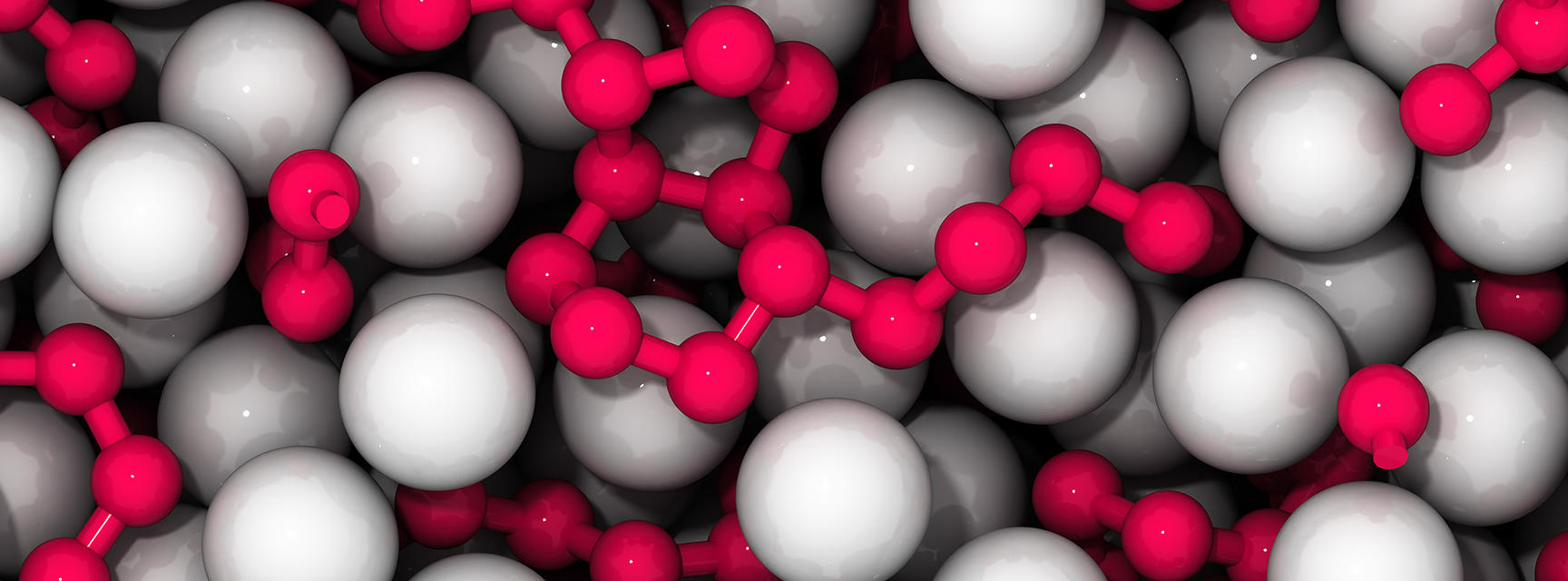
In their new work, the authors explore amorphous sodium–phosphorus Zintl phases, across the full range of compositions expected during SIB cycling. The simulations show how local bonding environments evolve during charging and discharging, combining the authors’ discussion of the classical Zintl–Klemm concept with functional materials. Building on earlier studies of amorphous phosphorus in the group (Adv. Mater., 2022; Angew. Chem. Int. Ed. 2023), the new work goes further by now modelling sodium-inserted structures and their evolution.
The new study, highlighted as a “Hot Paper” by the journal, addresses a key challenge in next-generation battery research. Lithium-ion technology, pioneered in part at Oxford, has powered decades of energy storage, but growing demand is now driving interest towards sodium ions instead, due to the element’s abundance and low cost. Elemental phosphorus has attracted attention as an SIB anode due to its exceptionally high theoretical capacity. In practice, however, its performance has been limited by rapid capacity fading and poor cycling stability, attributed to large volume changes and irreversible amorphisation during operation.
Unravelling how these volume changes arise at the atomic scale, and how evolving local bonding environments lead to irreversible structural damage, lies at the centre of work by the first author Litong Wu, a DPhil student at Oxford Chemistry and the OxICFM Centre for Doctoral Training.
Litong commented:
What I find most exciting is that machine-learning-accelerated simulations allows us to directly visualise and quantitatively analyse the atomic structure and dynamics of complex amorphous Zintl phases, and to understand them through one of the simplest and most elegant foundational theories in chemistry — something that may seem intuitive, but has never been systematically validated before.
Alongside energetic and structural analysis, the authors present a pilot simulation of the sodiation and de-sodiation process, offering dynamic insights that can complement experimental techniques. The authors hope that such ML-driven simulations can have broader relevance to the battery research community.
Professor Volker Deringer, senior author of the study, added:
I am extremely proud of Litong’s work, in which she combines three major research directions: ML-driven atomistic simulations, classic ‘textbook-type’ chemistry, and an application to amorphous battery materials. More widely, this paper is an example of the growing role of machine-learning methods in inorganic materials chemistry.
The paper is available via Open Access at https://doi.org/10.1002/anie.202508305. The authors’ research data are available openly as well, so that they can be readily used for further research.
The authors acknowledge funding from the EPSRC Centre for Doctoral Training in Inorganic Chemistry for Future Manufacturing (OxICFM) [EP/S023828/1], an Oxford Clarendon Fund Scholarship, and a Jesus College Clarendon Old Members’ Award. This work was also supported by UK Research and Innovation [EP/X016188/1] and via the UKCP consortium [EP/X035891/1].

