


Peptides for fluoride binding and catalysis
Researchers from the University of Oxford have developed the first peptide-based catalysts for asymmetric nucleophilic fluorination reactions.
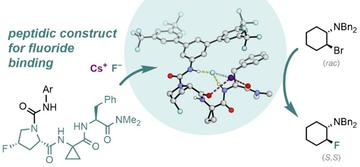
Fluoride can be a particularly challenging ion to work with: although peptides are known to bind other halides such as chloride, binding to fluoride had remained limited to computational studies until recently.
In this study, the team designed conformationally constrained peptides that can bind fluoride ions in a controlled manner through hydrogen bonding. This allowed them to solubilise the caesium fluoride salt and deliver fluoride in an enantioselective manner, i.e. selectively one mirror-image version of the product molecule.
Mechanistic studies revealed that the peptide binds both the fluoride anion and the caesium cation at the same time, helping to control the reaction.
The work, carried out in collaboration between Professor Véronique Gouverneur’s group at Oxford and the computational group of Professor Robert Paton at Colorado State University, was inspired by the fluorinase enzyme.
These findings identify peptides as a new class of fluoride-binding motifs for catalytic fluorination. The study offers insight into how molecular shape affects fluoride anion recognition – knowledge that can be applied in catalysis and other fields.
For further details, read the full study in JACS.

