
Autumn Chemistry Conference 2026
Booking has closed!
On Thursday 24th September, our Autumn Chemistry Conference will be delivered in the Inorganic Chemistry Laboratory, and streamed online. There will be an opportunity to ask questions during the event.
Open to students studying A-level Chemistry or an equivalent qualification (16-19 yrs) and their teachers and parents/carers interested in finding out more about the cutting edge research happening in the field of chemistry, and hosted by the Department of Chemistry, University of Oxford. Those yet to start a post-16 Chemistry qualification are more than welcome to attend however please be aware this conference is aimed at those already undertaking such a qualification. Please see below further information on the talks:
Shining Light on Reactive Molecules' Signalling Codes
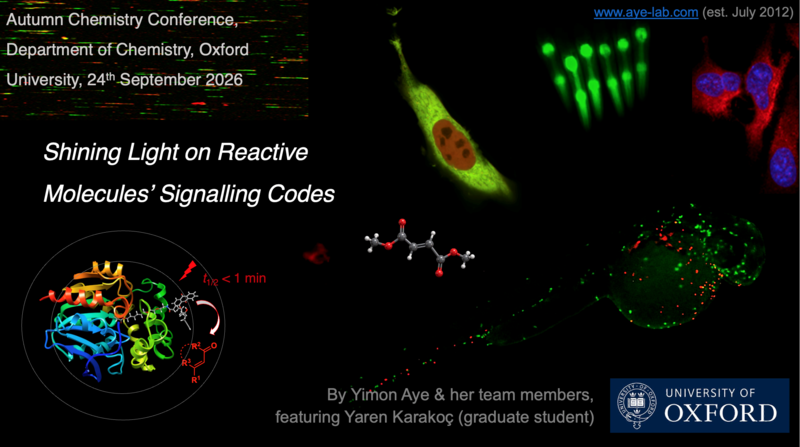
From the Rosetta Stone to AI, innovation starts with decoding hidden messages. This talk shows how the Aye laboratory is uncovering the chemical language of cells and using it to inspire scientific breakthroughs and future therapies.
Plasma Power: The Chemistry Behind Modern Electronics
Semiconductor chips power the technologies we use every day, from smartphones and laptops to vehicles, medical devices, and artificial intelligence. Manufacturing these chips depends on plasmas, energetic gases containing a complex mixture of atoms, molecules, ions, and electrons that are used to build and shape materials at microscopic scales. In this talk, Prof. Grant Ritchie will explore how scientists measure the chemical species present within these plasmas and why this is essential for making modern electronics. Although these species are invisible, they control the chemical reactions that create the tiny structures found in semiconductor devices. To ensure these devices work reliably, scientists must understand exactly which chemical species are present and how they behave. Using techniques such as laser spectroscopy, researchers can probe plasma chemistry in real time. The talk will provide an accessible introduction to these methods and show how measuring the unseen chemistry of plasmas helps enable the technologies that shape our daily lives.
About the speakers:

Prof. Yimon Aye A Professor of Chemistry and Chemical Biology at the University of Oxford and a Fellow at Pembroke College, Yimon Aye leads a research group that studies how small, reactive molecules help cells communicate and control important processes in the body. Her team is especially known for work on ‘electrophile signalling’, a type of chemical communication that affects many different activities inside cells, and they have also uncovered hidden aspects of nucleotide signalling pathways that help protect the genome (our DNA). Her group has developed innovative tools, including light-activated molecules, to study these processes more precisely in living systems. Using a mix of chemistry and biology techniques, her lab investigates how these signals work and how they relate to health and disease, including how some anti-cancer drugs function. Originally from Burma, Professor Aye’s career has taken her from Oxford to Harvard and MIT, and her research aims to support the development of new medicines and technologies. |
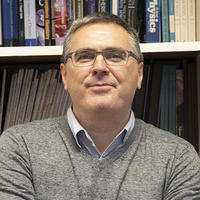
Prof. Grant Ritchie A Professor of Chemistry at the University of Oxford, Grant Ritchie leads a research group that develops advanced laser-based techniques to detect and study gases and chemical reactions. His work has applications in atmospheric chemistry, semiconductor manufacturing, and healthcare. In this talk, he will focus on plasmas - energetic gases used to produce the tiny electronic components found in modern computer chips - and how scientists can use highly sensitive laser techniques to study them. His group investigates the chemistry taking place inside plasmas to help improve industrial processes and develop new technologies, while also exploring applications in areas such as medicine and environmental science. Alongside his research, Professor Ritchie works closely with scientists, engineers and clinicians, and has written textbooks on atmospheric chemistry and physics for chemists. |
In-person Registration
Sixth form students are welcome to attend unaccompanied, provided they are aged 16 or over on the day of the event and that they have given us an emergency contact name and number (you will be able to provide this information on the form).
Priority for in-person spaces will be given to local state schools, but other local schools, and those further afield, are welcome to register for surplus places. A waiting list will apply and all those not allocated an in-person space will be invited to attend online.
We will be offering optional tours which will include an Oxford College and our brand-new self-guided chemistry-focused tour of the Ashmolean Museum (timed-entry applies), created in partnership with the Ashmolean Museum. All tours will run from around 12:00 - 15:15.
Booking has closed.
Online Registration
Online spaces are open to all students studying A-level Chemistry or an equivalent qualification (16-19 yrs) and their teachers and parents/carers interested in finding out more about the cutting edge research happening in the field of chemistry.
Booking has closed.

