


New strategy opens up oligonucleotide modification
A study from the Department of Chemistry, published in Nature Chemistry, reports a versatile new strategy for modifying synthetic oligonucleotides directly during their synthesis. The new approach uses an on-support phosphitylation strategy to overcome key limits of the current gold standard oligonucleotide synthesis method (phosphoramidite chemistry). The team’s work has also been highlighted in a Nature Chemistry Research Briefing.
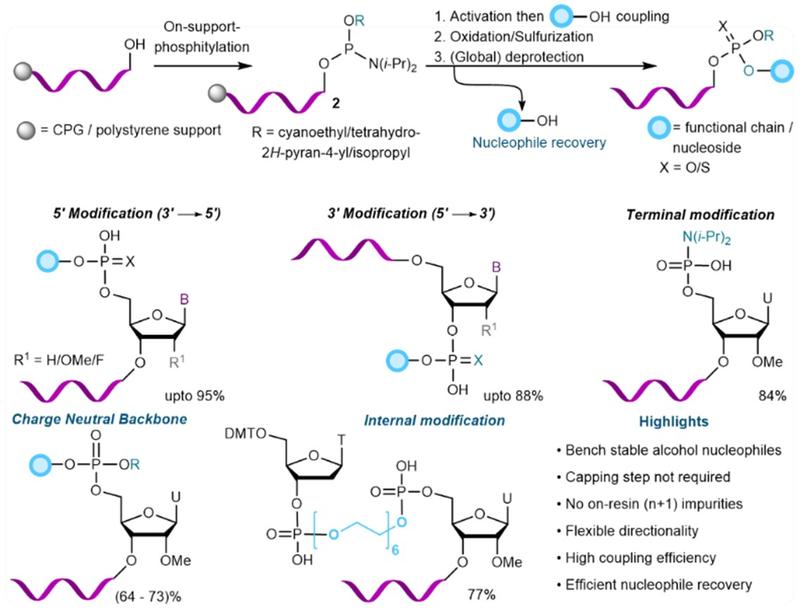
General synthetic strategy for on-support phosphitylation of growing oligonucleotide chains, enabling functionalisation and chain extension (Top). Diverse functionalized oligonucleotides are accessible through on-support phosphitylation, including 3ʹ modifications, charge neutral backbones and internal modifications (Bottom).
Oligonucleotides – short strands of DNA or RNA – are essential tools in chemical and molecular biology, with applications including gene regulation, molecular diagnostics and nucleic acid therapeutics.
In the laboratory they are typically assembled step-by-step using phosphoramidite chemistry, an automated process that allows scientists to assemble a diverse range of nucleotide sequences with different chemical functions.
Introducing new chemical modifications typically requires a dedicated phosphoramidite building block for each functionality. These reagents can be expensive and limited in range, while phosphoramidites are sensitive to air and moisture and generally used in excess. Unused material can also be difficult to recover. These limitations create a need for simpler and more flexible approaches to oligonucleotide functionalisation.
Dr Ayan Dasgupta, a postdoctoral researcher jointly supervised by Prof Tom Brown and Prof Ed Anderson, led the development of a direct on-support strategy for oligonucleotide functionalisation via on-support phosphitylation in collaboration with DPhil student Sebastian Golojuch and Eli Lilly scientists Dr Nour Eddine Fahmi and Dr Li Xiao.
The new method directly phosphitylates a hydroxyl group at the end of the oligonucleotide while it is still attached to the solid support, in a process known as on-support phosphitylation. This avoids the need to prepare a specialised phosphoramidite building block for each new chemical group.
The researchers used the approach to add a wide range of groups to oligonucleotides, including lipids, fluorophores, azides, amines and thiols, and to extend oligonucleotide chains with additional nucleosides. The modified oligonucleotides that were made using this straightforward strategy were typically synthesised with high conversion rates and did not require protecting-group manipulation.
The strategy can, in principle, be used at either end of the strand, making it compatible with oligonucleotide chain extension and modification in both the conventional (3' → 5') and reverse (5' → 3') directions.
Another advantage of this approach is that unused alcohols and nucleosides can be recovered and reused in subsequent coupling reactions.
The study establishes a new way to modify and extend oligonucleotides without having to prepare a specialised phosphoramidite reagent for every new functionality. It could provide a simpler and more flexible route to chemically diverse oligonucleotides for applications in chemical biology, molecular imaging and nucleic acid therapeutics.
Joel Cejas-Sánchez, Associate Editor of Nature Chemistry, said: ‘The synthesis of oligonucleotide therapeutics relies on phosphoramidite building blocks, which are highly sensitive compounds. What caught my attention in this work was the distinct approach to avoid the current limitations, enabling selective modification at the 5' and 3' termini and internal sites of synthetic oligonucleotides with very broad scope and high coupling efficiencies.’
Read more in Nature Chemistry, and their Research Briefing.

