


New method reveals hidden properties of organic light-emitting materials
Researchers have developed a new experimental approach that makes it up to 1,000 times easier to study important excited states in a widely studied class of organic light-emitting materials. The method, developed by an international collaboration involving Oxford’s Department of Chemistry, reveals properties in some molecules that conventional techniques have been unable to detect.
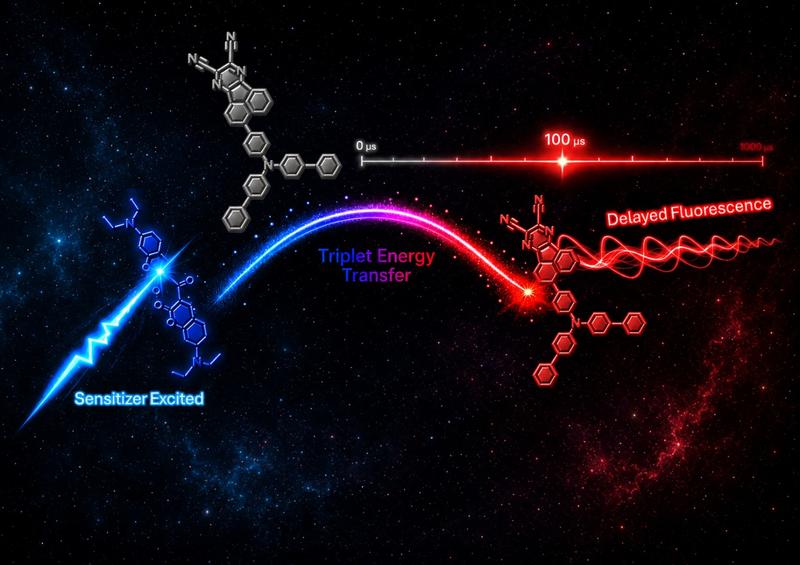
Artist’s illustration of sensitizer induced thermally activated delayed fluorescence. Credit: Oliver Millington.
The study, published today in the Journal of the American Chemical Society, focuses on materials that exhibit thermally activated delayed fluorescence (TADF). Organic dye molecules can temporarily store energy within excited states, and TADF molecules are particularly exciting because they can unlock the energy stored in triplet excited states that is normally inaccessible to conventional organic dyes. The triplet states of TADF molecules underpin their potential for technologies ranging from high-performance organic light-emitting diodes (OLEDs) for displays and lighting, to bioimaging in the life sciences and medicine, and photocatalysis for driving chemical reactions.
Being able to access and study the triplet states of TADF molecules is therefore crucial to understanding how these materials work. Researchers can observe what happens to these triplet states through ‘delayed fluorescence’, i.e. light emitted microseconds to hundreds of microseconds after the molecules are initially excited. In the typical experiment used to investigate TADF, researchers shine light directly onto the material and must rely on the molecules themselves to generate triplets through a process called intersystem crossing before they can study what those triplets do. This creates an important limitation because the experiment effectively measures two processes in sequence: how efficiently the molecule generates triplets, and what it does with them once they have been generated.
Dr Dan Congrave, Royal Society University Research Fellow at Oxford Chemistry and one of the authors of the study, said:
At the moment, to study what TADF molecules do with triplet states, we first rely on them to generate those triplets themselves. This means that the behaviour we actually want to understand can be obscured by the process that comes before it. As fewer triplets are generated, their behaviour becomes increasingly difficult to analyse. If almost no triplets are generated, we may even draw the wrong conclusions about what the molecule is capable of doing.
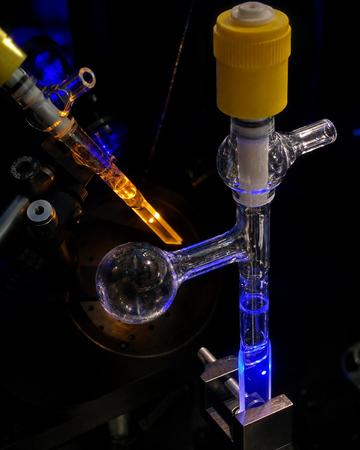
The experiment in action: Triplet sensitisation promotes delayed fluorescence for different colour TADF molecules (composite image). Credit: Oliver Millington, Erin Holdsworth.
This limitation is becoming increasingly relevant as TADF materials are diversified. Earlier generations of TADF molecules commonly converted more than 75% of their optically excited molecules into triplet states, making their triplet behaviour relatively easy to study. By contrast, some modern TADF materials, developed in part to improve the efficiency and operating lifetime of blue OLEDs, generate triplet yields below 5%.
The international team developed a simple way to separate triplet generation from triplet behaviour. Rather than relying on TADF molecules to generate their own triplets, the researchers introduced a second molecule known as a triplet sensitiser that is exceptionally good at producing triplets. By carefully choosing the sensitiser and wavelength of light, they could excite the sensitiser molecules almost exclusively, which efficiently generate triplets before transferring them to the TADF molecules through molecular collisions in solution.
Put simply, triplet sensitisation supplies the triplets directly, allowing researchers to focus on what a TADF molecule does with triplets independently of how efficiently it can generate them itself.
The team demonstrated that the approach could be applied across a diverse family of TADF materials, with emission ranging from blue to near-infrared and with very different excited-state lifetimes. In the most striking cases, triplet sensitisation improved the detectability of delayed fluorescence by 1,000 times, converting phenomena previously close to the limits of instrumental sensitivity into routine measurements.
Most importantly, the improved experiment revealed behaviour that had previously gone unnoticed, particularly in TADF molecules that absorb and emit near-infrared light. These materials are of considerable interest for technologies including solar-energy conversion, biological imaging and sensing.

Erin M. Holdsworth and Dr Oliver Millington, who each led the experimental studies through different phases of the project. Credit: Steph Montanaro.
For several TADF molecular families, delayed fluorescence has historically been observed primarily – or exclusively – in the solid state. In conventional experiments, the key molecule highlighted in the study shows essentially no delayed fluorescence on the microsecond timescale in dilute solution. This has led researchers to attribute its TADF behaviour solely to interactions between neighbouring molecules rather than to the properties of the individual molecules themselves. The new experiment reveals that for some pioneering materials these earlier conclusions may not be quite right. When triplets were supplied directly, delayed fluorescence became clearly visible in dilute solution. The molecular machinery required to access the energy in triplet states independent of solid-state interactions was already there, but it generated too few triplets for conventional experiments to reveal what it could do.
Dr Oliver Millington, a postdoctoral researcher and one of the first authors of the study, said:
By separating triplet generation from triplet harvesting, the new methodology can reveal otherwise hidden photophysical properties and help researchers unpick subtle but significant details in the operating mechanisms of cutting-edge device materials. If important behaviour cannot be observed, it cannot be fully understood. And without understanding how molecules really work, we cannot effectively solve their limitations or design the technologies that come next.
The research was carried out through an international collaboration involving researchers at the University of Oxford and University of Cambridge (UK), Uppsala University and Linköping University (Sweden), and Zhangjiang Laboratory (China), bringing together expertise in molecular materials, photophysics, spectroscopy and theoretical chemistry.
Read more in the Journal of the American Chemical Society.

