


Constructing chemistry’s missing pieces with light
If you've ever assembled flatpack furniture, you'll no doubt have experienced the frustration of searching for a single specific piece amongst a small mountain of nuts, bolts, and screws. You know exactly the bit you're looking for – how big it is and what shape it should be – but you just can't seem to find it anywhere and there's no way you'll finish putting up those shelves without it.
Chemists often have this same problem, albeit at a molecular level.
Many of the everyday chemicals we take for granted – drugs, agrochemicals like fertilisers and pesticides, even the flavourings in food – rely on a similar assembly process: scientists start from a single small piece and build up the molecule bit by bit through a long sequence of chemical reactions. They know exactly what they're trying to make, which chemical fragments they’ll need and in what order they should put them together. But sometimes, amongst all the possible chemical reactions, they can't find a single one which is able to build the right piece

Bicyclopentanes (BCPs) are just one of these useful but elusive molecular fragments. Their rigid, three-dimensional structure is particularly important in drug design: the cage-like shape can lock the wider molecule into a single active form, while the two “arms” of the BCP unit sit exactly opposite each other and can be used to replace the flat benzene rings often found in pharmaceutical candidates to improve their properties. An example of this is the drug darapladib, which was developed by GSK to treat atherosclerosis. The compound had the correct biological effect, but it didn't dissolve well in the blood and was consequently removed from the body too quickly to work. But, when the GSK team replaced the benzene unit with a BCP, both the solubility and the lifetime of the molecule improved, making the new version a much better drug candidate.
 |
 |
 |
 |
However, the three fused rings of carbon atoms that make up BCPs create a very congested structure. It’s therefore extremely difficult to force reaction intermediates to adopt this high-energy shape, without employing harsh conditions that would destroy the rest of the molecule in the process. As a result, there are very few ways to construct this much sought-after unit, leaving chemists with that frustrating missing-piece feeling.
Researchers at the University of Oxford developed a light-powered strategy to assemble these knotty molecules, creating a new and shorter route to reach valuable drug compounds such as darapladib. Beginning from the super-strained starting material propellane and an organic iodide partner, the new reaction relies on a technique called photoredox catalysis.
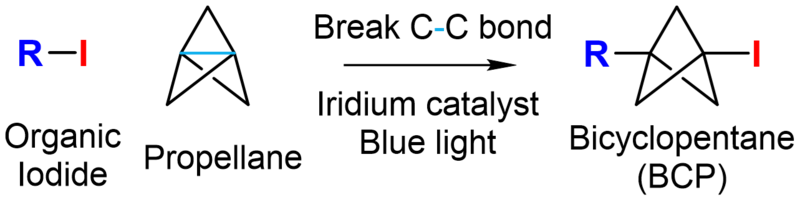
The team shone blue LEDs on an iridium metal catalyst, exciting the electrons in the metal to a high-energy state. These excited electrons promptly attacked the organic iodide, breaking the carbon–iodine bond to create an extremely reactive organic radical (single-electron intermediate). In a rapid cascade of events, the organic radical intercepted the propellane starting material, springing open the high energy bond in the centre of the molecule. This broken bond then snatched the iodine from another molecule of organic iodide, forming an organic–BCP–iodine unit and starting the cycle again.
Crucially, this iodine arm acts as an attachment point, meaning the researchers could clip the new BCP molecule onto existing organic compounds including antibiotics, pesticides, and non-steroidal anti-inflammatory drugs. Overall, the reaction provides a gentler and more general way to both prepare and attach this valuable piece, a tool which will make it easier and faster for scientists to discover and manufacture the important everyday organic compounds modern life depends upon.
This is Research Companion 001, part of Compounds of Interest, an Oxford Chemistry series exploring our research. Read the research paper behind this article: https://doi.org/10.1021/acscatal.9b03190
Acknowledgements: The Department is grateful to Wadham College for supporting the Compounds of Interest series through its Access programme. This Research Companion was written by Oxford Chemistry alum Dr Victoria Atkinson, in collaboration with the Compounds of Interest team and contributing researchers.

