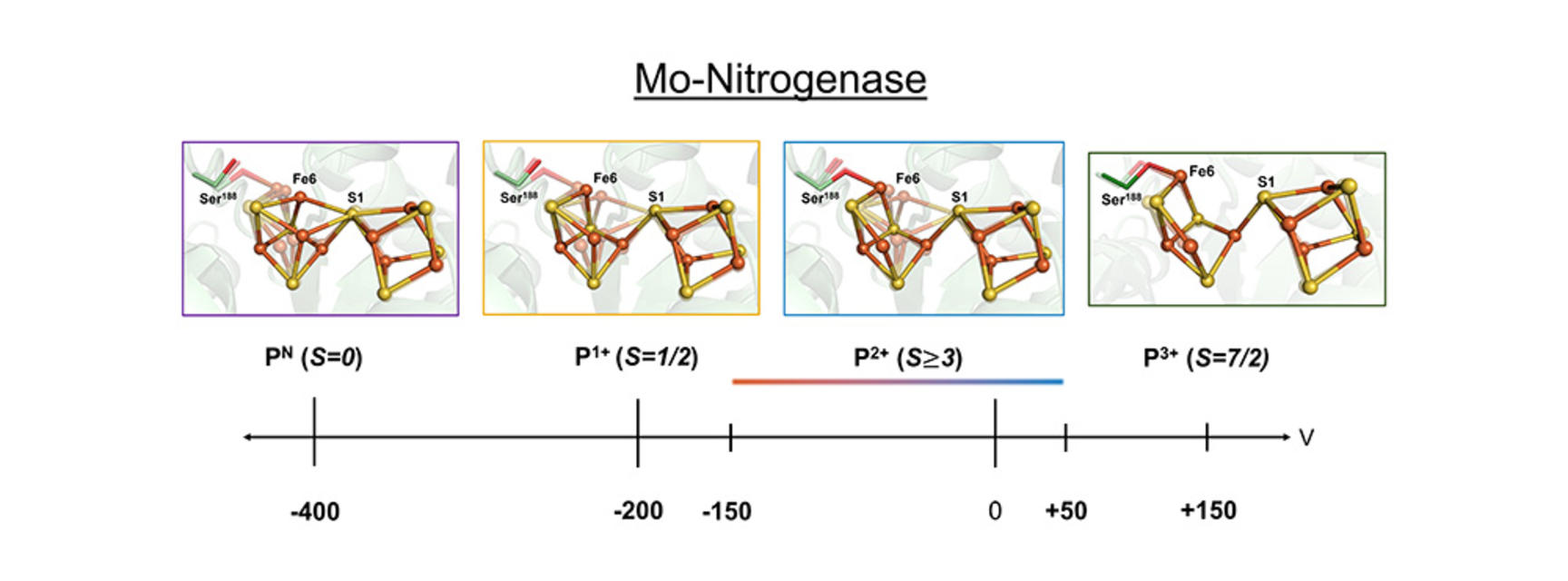
Researchers from the University of Oxford and Utah State University have captured nature’s catalyst for nitrogen fixation in four distinct oxidation states, revealing how an iron–sulfur cluster within the enzyme opens up during catalysis.
Using electrochemistry to manipulate single crystals of the nitrogenase enzyme, the Oxford team were able to trap the crystals as they took up successive electrons. Electron paramagnetic resonance (EPR) spectroscopy measurements at Oxford’s CAESR facility allowed the team to verify the states of the crystal samples before structural characterisation.
Published in the Journal of the American Chemical Society, the work suggests how structural reorganisation of the unusual electron-relay ‘P-cluster’ in nitrogenase could help drive the sequential transfer of multiple electrons through the enzyme as it synthesises ammonia from nitrogen gas.
Ammonia is a critical component of agricultural fertilisers, with more than 70% of global production (240 Mt) used for food production. It also has potential as a clean fuel because of its high energy density relative to hydrogen. Industrially, ammonia is produced using the energy-intensive Haber–Bosch process. Nature, however, performs the same fundamental chemistry under ambient conditions using the enzyme nitrogenase. Understanding how the metal–sulfide clusters of this enzyme achieve this chemistry has been a long-standing challenge in bioinorganic chemistry.
Molybdenum nitrogenase, the most widespread nitrogenase, contains two key metal clusters: the catalytic iron–molybdenum cofactor (FeMoco, or M-cluster) and a neighbouring 8Fe–7S centre (the P-cluster), which supplies the electrons required for dinitrogen reduction in an ATP-dependent process. Catalysis requires the controlled accumulation and transfer of multiple electrons and protons at FeMoco, but the individual redox states involved have proved very difficult to isolate experimentally.
Unlike many biological iron–sulfur clusters, which remain rigid during electron transfer, the P-cluster undergoes substantial structural rearrangement as its oxidation state changes. Three main states (PN, P1+, P2+) have been implicated in nitrogenase function, but their detailed structures have been difficult to define, particularly that of the important catalytic intermediate P1+ state.
The resulting structures reveal a striking sequence of movements centred on two iron atoms within one half of the P-cluster. In the fully reduced PN state, the cluster adopts the established ‘closed’ conformation. Oxidation to P1+ produces an intermediate ‘half-open’ arrangement, in which two iron sites move away from the central sulfur atom. Further oxidation to P2+ yields the familiar ‘open’ state, with one iron site coordinated by the backbone amide of a cysteine residue and another by the side-chain oxygen of a serine.
Across the series, the surrounding protein backbone changes remarkably little. Instead, the major structural response is localised to the metallocluster itself, highlighting how changes in coordination around the iron centres may tune electron transfer. Together, the structures provide a frame-by-frame picture of the P-cluster rearranging as the enzyme moves between redox states.
The electrochemical poising methodology developed by the Vincent group is likely to prove valuable in future studies aimed at capturing elusive catalytic intermediates at the active site and revealing how nature drives multielectron N₂ reduction so efficiently.
You can read more in JACS here.
Banner image: Crystals of MoFe nitrogenase trapped in specific P-cluster redox states using in crystallo electrochemical poising.