


Oxford chemists reinvent the Mitsunobu reaction
Oxford researchers have developed a new set of iminophosphorane reagents that overcome longstanding limitations of the Mitsunobu reaction, one of the most widely used transformations in synthetic organic chemistry. Published in Nature Synthesis, the breakthrough expands the range of chemical bonds that can be formed directly from alcohols, and offers practical advantages over current methods.
For almost 60 years, the Mitsunobu reaction has been a cornerstone of organic synthesis. This widely used reaction provides a powerful way to transform readily available alcohols into valuable molecules by forming carbon–oxygen (C–O), carbon–nitrogen (C–N) and carbon–sulfur (C–S) bonds with predictable control over their three-dimensional arrangement.
Despite its versatility, the classical reaction has several well-known drawbacks. It relies on potentially hazardous azodicarboxylate reagents, often requires laborious purification, and operates within a narrow acidity (pKₐ) window that severely restricts the range of compatible reaction partners. In particular, forming carbon–carbon (C–C) bonds using the traditional Mitsunobu approach has remained a longstanding challenge.
Now, researchers in Professor Darren Dixon's group at Oxford Chemistry have developed a fundamentally new approach that addresses these limitations.
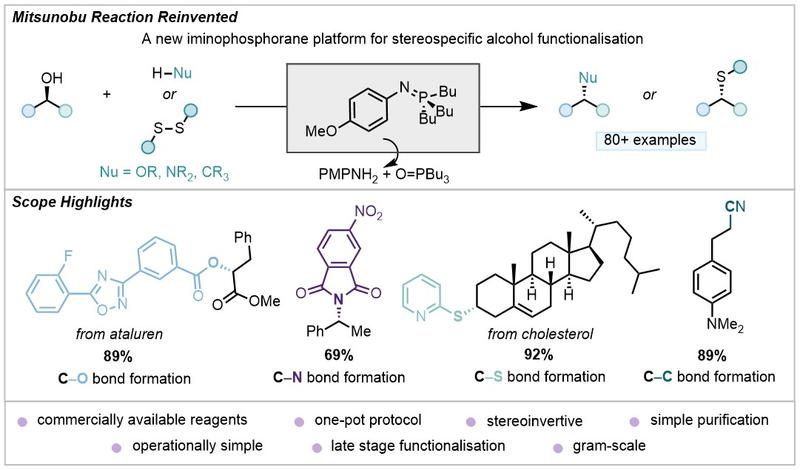
Mitsunobu reaction reinvented. A new iminophosphorane reagent platform enables stereospecific alcohol functionalisation, including C–O, C–N, C–S and C–C bond formation. Demonstrated across more than 80 examples, the methodology combines commercially available reagents, a straightforward one-pot protocol and simplified purification, with applications including late-stage functionalisation of complex molecules and gram-scale synthesis.
The breakthrough centres on a new set of iminophosphorane reagents, generated directly in the reaction mixture from commercially available aryl azide and trialkylphosphine.
This approach enables the stereospecific functionalisation of alcohols through a straightforward, one-pot procedure. Crucially, it retains the versatility of the classical Mitsunobu reaction while extending its scope to C–C bond formation, alongside the more familiar C–O, C–N and C–S couplings.
The new method also offers attractive practical advantages by eliminating the need for conventional azodicarboxylate reagents and simplifying purification. More than 80 examples demonstrate the breadth of the chemistry, including late-stage functionalisation of complex molecules and gram-scale reactions.
Prof Dixon explains how the discovery emerged from an unexpected connection between two areas of organic chemistry:
The starting point was thinking about the mechanism of iminophosphorane hydrolysis. When I looked closely at the individual steps, I realised they bore a remarkable resemblance to the activation mode of the Mitsunobu reaction. That led us to ask a simple question: could an iminophosphorane serve as the reagent for Mitsunobu reaction itself?
“That mechanistic connection ultimately opened the door to a completely new class of reagents for the Mitsunobu reaction, allowing us to overcome several longstanding limitations of this important transformation.”
The research was driven by DPhil student Maud Tregear, who led the experimental development of the new chemistry from initial concept through to its successful demonstration, with important contributions from Shisato Yamamura.
Prof Dixon added:
“Maud has driven this project from concept to completion with tremendous creativity, speed and persistence. It's been a real pleasure to see the chemistry develop from an initial mechanistic idea into such a versatile and practically useful methodology. Shisato also made important contributions to bringing the work to fruition.”
The ability to form a wider range of chemical bonds directly from alcohols could have far-reaching implications for synthetic organic chemistry, particularly in medicinal chemistry, pharmaceutical research and the development of agrochemicals and fine chemicals, where efficient, versatile and stereochemically controlled synthetic methods are highly valued.
Recognising the potential of this new technology, the team has worked closely with Oxford University Innovation to file a patent application that covers the iminophosphorane reagent platform and its applications.
Prof Dixon commented:
We believe the commercial potential of this technology is enormous. The ability to transform readily available alcohols into such a broad range of valuable products, using operationally straightforward chemistry, opens up exciting possibilities across the chemical industries. We're particularly enthusiastic about its potential in the pharmaceutical, agrochemical and fine chemical sectors, where new and enabling synthetic technologies can make a real difference.
“We're keen to engage with chemists and organisations across these industries to explore how the technology might be developed and applied, whether through research collaborations, licensing agreements or potentially even the creation of a spin-out company. This is just the beginning, and we'd be delighted to work with partners who can help take the technology forward.”
You can read the full publication, “Mitsunobu reactions using iminophosphorane reagents”, by Maud T. H. Tregear, Shisato Yamamura and Darren J. Dixon, in Nature Synthesis: https://doi.org/10.1038/s44160-026-01205-2.
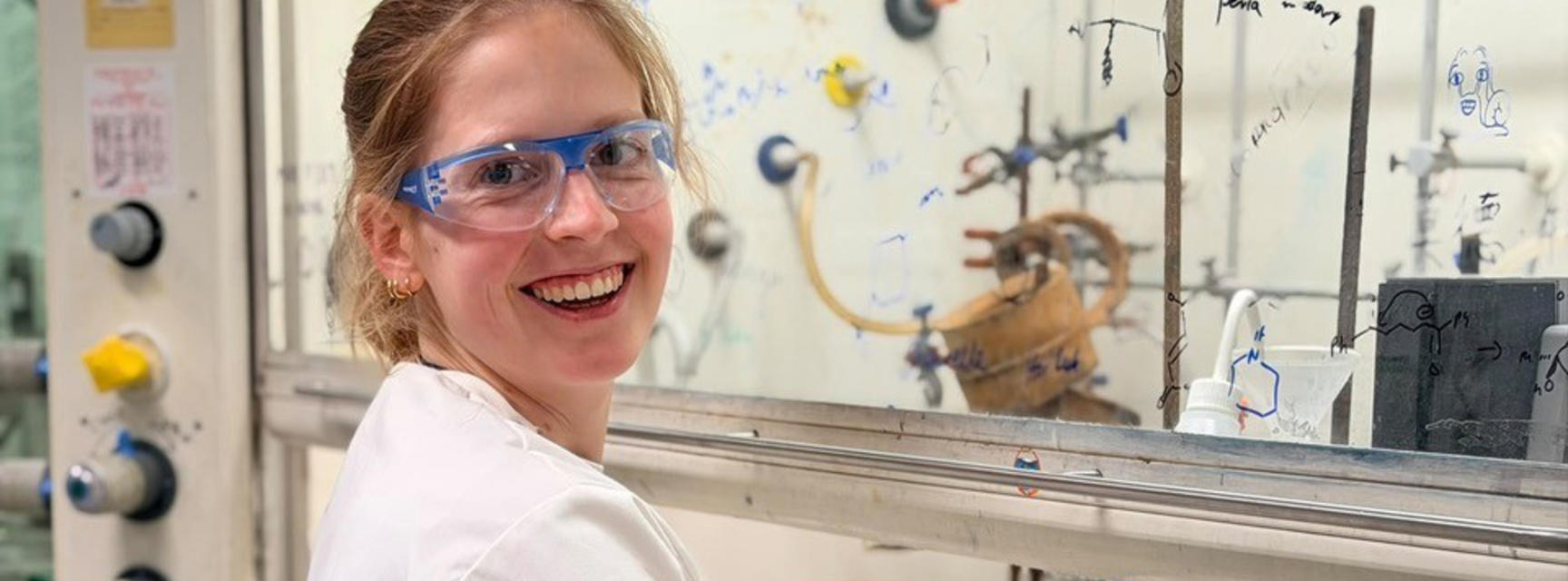
Banner image: Maud Tregear, who led the development of a new approach to the Mitsunobu reaction, working in the Department of Chemistry at the University of Oxford.

