


Radiomedicine, best served fresh

Some food is best used immediately – anyone who's ever tried to prepare a fancy fruit dessert will know that apples and bananas start to turn brown from the moment you cut them! But working to this breakneck timetable isn't always convenient, particularly when there are multiple dishes to prepare, so experienced chefs have a number of tricks to extend the life of their star ingredients.
Chemists often encounter the same difficulty, with some reagents spoiling before it's possible to use them in a chemical reaction. This is always frustrating, but it becomes especially problematic when the resulting compounds must be available immediately and on demand, for example, in a hospital radiopharmacy, where purity and quality control requirements are necessarily stringent.
These medical departments specialise in preparing compounds containing radioactive labels which are used to both treat and diagnose conditions ranging from cancer to heart disease. Medical imaging techniques such as Positron Emission Tomography (PET) scans rely on a subset of these radioactive compounds called radiotracers. The patient is injected with the radiotracer just before their scan and, as the radiotracer moves through the body, the radioactive atoms decay, releasing signals which are then detected by the scanner to create an image.
The most common radioactive label used clinically is the atom fluorine-18, but with a rapid breakdown rate of 50% every two hours, the radiotracer can only be prepared immediately before it is administered to the patient. Consequently, the bulk of the tracer must be prepared in advance and contain a stable placeholder which the hospital’s radiochemist can quickly swap out for fluorine-18 right at the last minute. This stand-in chemical group must be simultaneously tough enough to survive long-term storage, but at the same time reactive enough to exchange immediately on-demand – a difficult balance to strike.
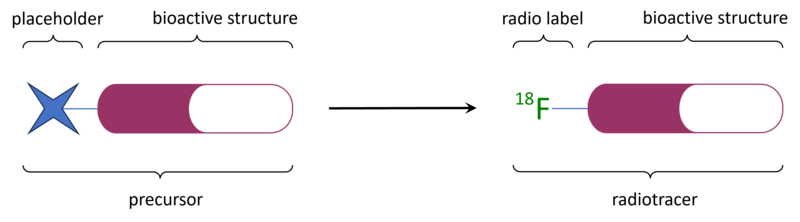
Back in 2014, researchers at the University of Oxford showed that a placeholder called a Bpin was easy to attach to a variety of different tracers and the reaction to replace it with fluorine-18 was simple and efficient. However, the resulting precursors would sometimes fall apart during storage or purification, creating a mixture of compounds that then couldn't be used with patients.
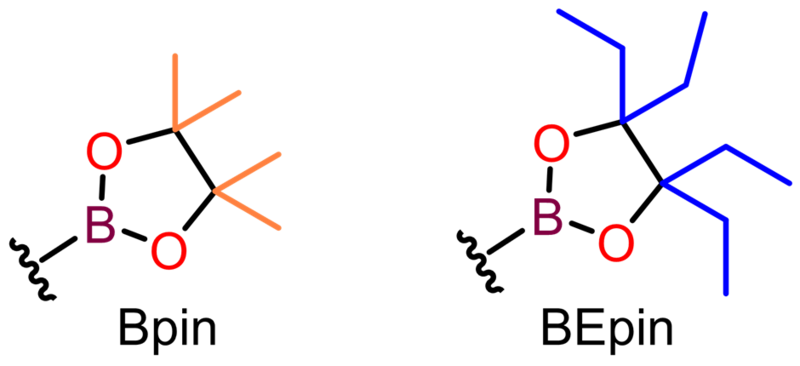
After extensive research, the same group later developed a more robust alternative called BEpin, which uses a subtle structural modification to boost the stability of this stand-in unit. Swapping the single-carbon methyl groups on Bpin (orange) for the two-carbon ethyl groups in BEpin (blue) effectively shields the most reactive part of the molecule, preventing the placeholder from spoiling before it’s needed.
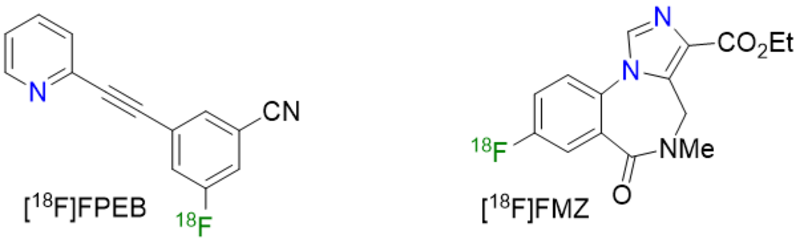
The team also needed to ensure that the same speedy swap with fluorine-18 was still possible with this new unit. Using a copper catalyst and a fluorine-18 reagent, they tested the standard reaction conditions on a library of starting materials and prepared 18 different radioactive molecules. This included the PET radiotracers FPEB and FMZ used in clinical medicine and research, which are being investigated for imaging brain disorders, such as Parkinson's disease, depression and epilepsy.
Much like a chef squeezing lemon juice on chopped apple to prevent it turning brown, simply swapping a Bpin for a BEpin can keep these reagents good for longer, providing a reliable supply of stable precursors , making it easier to prepare these essential radiotracers exactly to order. This streamlined supply will mean fewer cancelled scans, while the quick and clean reaction sequence produces a purer radiotracer. Taken together, radiologists can rapidly produce crisp and accurate images, supporting timely patient diagnosis.
This is Research Companion 003, part of Compounds of Interest, an Oxford Chemistry series exploring our research. Read the research paper behind this article: https://doi.org/10.1039/d6sc04824b
Acknowledgements: The Department is grateful to Wadham College for supporting the Compounds of Interest series through its Access programme. This Research Companion was written by Oxford Chemistry alum Dr Victoria Atkinson, in collaboration with the Compounds of Interest team and contributing researchers.

