


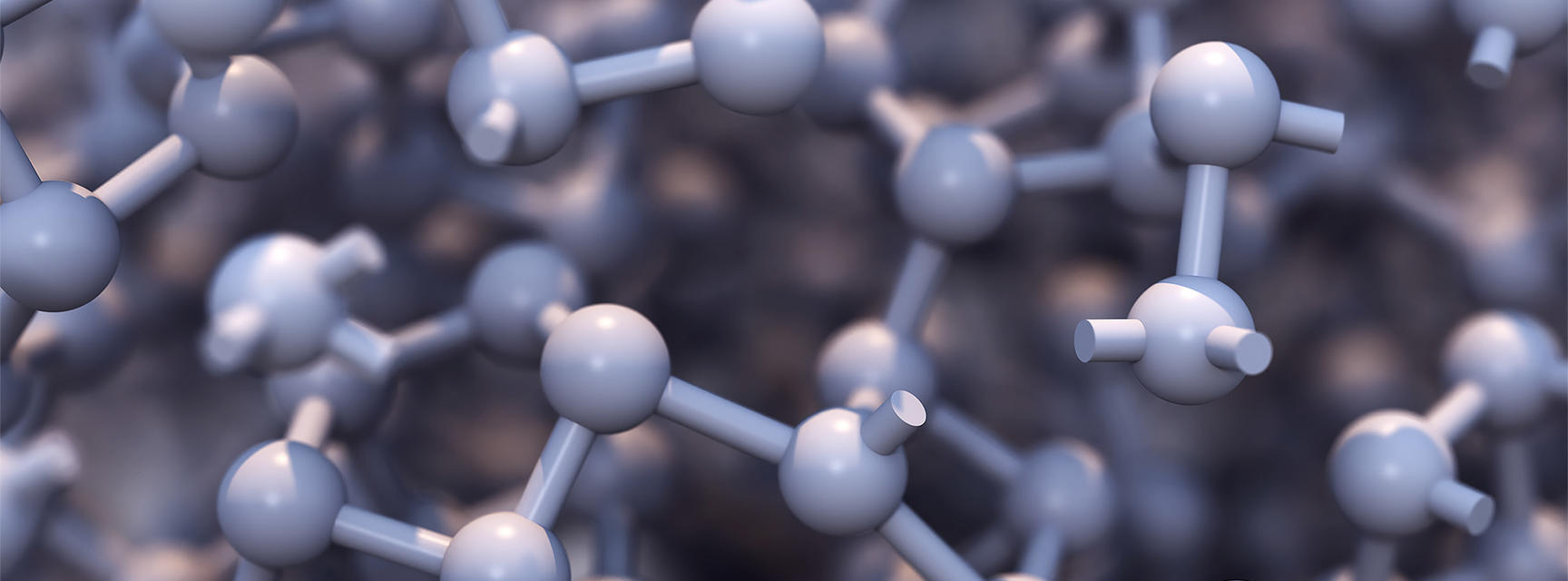
A threefold-coordinated continuous random network
4 March 2026
The amorphous state – where atoms are arranged without the long-range structural order found in crystals – has long posed fundamental questions. A study led by Oxford Chemistry researchers now provides new structural insights into amorphous elemental arsenic (a-As).
The paper, published in the Journal of the American Chemical Society, reports machine-learning-driven atomistic simulations of a-As. The study focuses on medium-range structural order, beyond the length scale of individual local coordination environments and bonds.
The authors demonstrate that a-As can be well approximated as an extended structure where the local atomic environments are clearly-defined, but there is no long-range order. This is known as a continuous random network (CRN) model. In this way, a-As resembles the widely-studied amorphous silicon (a-Si), but with its atoms threefold coordinated, rather than fourfold in a-Si. This means that a-As assembles into a different type of CRN to a-Si . The authors also show that the structural nature of a-As is different from that of its lighter homologue, red amorphous phosphorus (a-P).
The origin of this structural diversity lies in the torsional flexibility of chemical bonds. In a-P, molecule-like fragments with relatively fixed dihedral bond angles dominate, whereas a-As shows a more uniform distribution of those angles. While descriptions of a-As as a CRN date back to the 1970s, the present study now provides quantitative support, using quantum-mechanically-accurate simulations with machine-learned interatomic potentials (MLIPs).
The experimental yardstick is the first sharp diffraction peak (FSDP) in the structure factor of X-ray or neutron-diffraction patterns, associated with medium-range order. The authors show that the FSDP height and position can be well reproduced by MLIP-driven simulations.
This new study showcases the use of autoplex, an open-source software framework developed jointly with Prof Janine George and her team at BAM Berlin and the University of Jena (see a previous news item here). Using automated workflows for initial structural exploration and MLIP fitting, the authors were able to create a high-quality potential model for a-As at modest computational cost. This way, automation allows researchers to focus on exploring chemistry questions, while keeping oversight of the MLIP development and validation process.
The main computational work was carried out by Dr Yuanbin Liu, a former postdoctoral researcher in the Deringer group at Oxford. It builds on earlier pilot studies from a Part II research project by Richard Ademuwagun, guided by Dr Yuxing Zhou who is now a Schmidt AI in Science research fellow at Oxford Chemistry.
Prof Stephen Elliott, Visiting Professor in Oxford’s Physical and Theoretical Chemistry Laboratory, commented:
I am delighted to have taken part in this benchmark simulation study of a-As using state-of-the-art MLIPs. It is a particular pleasure, since one topic of my PhD, many decades ago, involved the analysis and refinement of a (literally) ‘ball-and-stick’ CRN model of a-As – how the methods of materials simulation have changed in that time!
Prof Volker Deringer, Professor of Materials Chemistry in the Inorganic Chemistry Laboratory and senior author of the study, commented:
Amorphous materials have seemingly random structures, but there are subtle chemical rules for how exactly the atoms connect. ML-driven simulations now allow us to study these rules, and these materials, with a degree of realism that would otherwise be out of reach. I look forward to continuing to work with my group and collaborators in this exciting research field.
The paper is available in JACS via Open Access at https://doi.org/10.1021/jacs.5c18688.

